
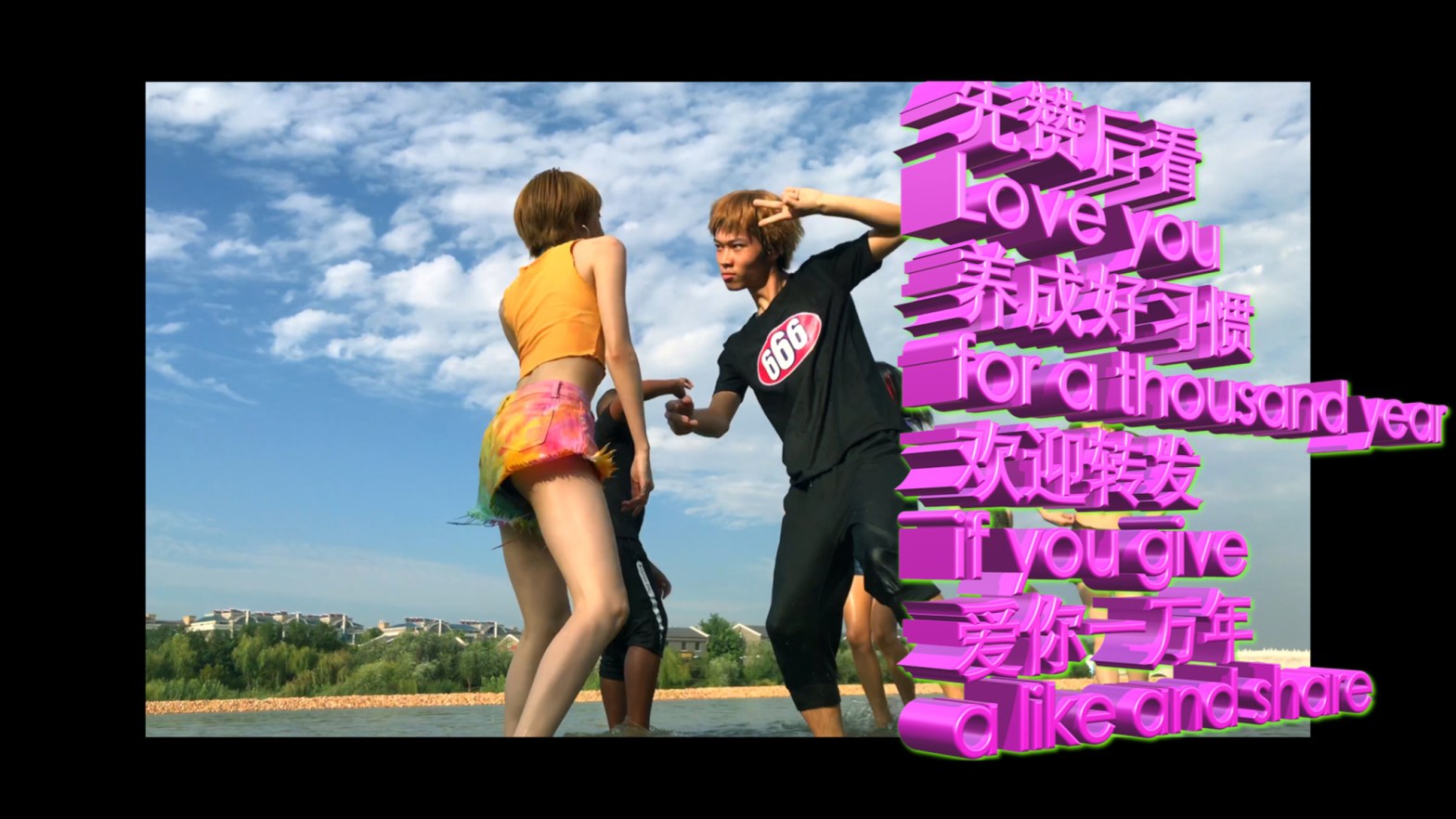
In one of Gagaland’s visual effect abundant sequences, the characters face the audience, walking ahead in a rainbow-coloured limbo filled with flashing emojis and glittering texts floating across the screen. Quick editing allows jumps from one dreamscape to another as smoothly as a swipe of a finger between different reels posted on social media apps. However, this 85-minute-long music video is not as experimental as it appears at a first glance.

Immediately after the premiere of Gagaland, many film critics at the International Film Festival Rotterdam asked, “Is this film still cinematic?” The question implies a concern about the future of cinema, which is considered endangered by short video content on social media and the way it modifies audiences’ visual literacy. The debut full-length fiction feature by 23-year-old Téng Yǔhán 腾语涵 is inspired by this dreaded form of visual culture—specifically, short videos posted on the social media platform Kuaishou. She sees it as having the potential to give voice to those underrepresented in Chinese official media, since many short videos posted there are made by people living in the Chinese countryside. Immersed deeply in the reality of third- and fourth-tier cities in Central and Northeast China, Gagaland is a tribute to the golden age of the social and online phenomenon it portrays—ga-dance (gàwǔ 尬舞)—a freestyle street dance that started trending on Kuaishou in the 2010s. It does not have any specific choreography or form, but is based on pure improvisation, which gives unlimited space for self-expression and the exertion of individual agency in dance. Gagaland’s ostensibly simple and cliché storyline allows a chaotic stream of images and movement to take over the viewing experience.

Gagaland follows a zero-to-hero, boy-meets-girl storyline. K.Dì (K弟), a 16-year-old from Inner Mongolia, leaves his job at a duck feather factory and, while escaping from bullies, accidentally joins a group of livestreamers dancing on a street corner. He soon becomes part of this crew, led by the charismatic 50-something Pink Hair (红毛 hóng máo), who earns a living online through virtual gifts in the form of emojis purchased by followers. K.Dì joins the group and begins livestreaming alongside three other dancers—B Girl (霹雳女 Pīlì nǚ), Shuǐxiān (水仙), and Kennedy (肯尼迪)—fellow vagrant young migrant workers or left-behind children turned teenagers. K.Dì’s dance and personal style quickly attract attention, amassing more and more fans. He falls in love with B Girl and starts dreaming of getting rich in order to give her a better life. Gradually convinced that Pink Hair keeps all the income from livestreaming for himself, K.Dì considers joining a rival dance crew whose leader offers him a large share of their revenue.

Teng Yuhan had been fascinated by ga-dance from its boom in 2014 until its decline by the end of the decade, following a series of protests that labeled the dance as vulgar and a sign of bad taste. It was targeted even more viciously than the beloved pastime of China’s elderly—square dancing (guǎngchǎng wǔ 广场舞)—because ga-dance was accused of immorality and overtly sexual dance moves used to gain followers and virtual gifts. Teng Yuhan describes ga-dance as “different from all other dances in China. In square dance, we must be consistent and united, while ga-dance celebrates individualism and difference. The more original, the better. It is a dance that is an expression of happiness. I think it is very courageous and brave. There is a saying, ‘happy is also revolution,’ which is an idea I very much agree with.”
However, Gagaland pays tribute to a specific dance scene in Zhengzhou rather than to ga-dance in general. In her work as a filmmaker and visual artist, Teng Yuhan is strongly influenced by subcultures that began to consolidate online via forums, blogging, and livestreaming, since she herself came to know them from the perspective of a fan and follower. Pink Hair (real name Gù Dōnglín 顾东林) is, in fact, a real-life online celebrity who became the protagonist of the 2018 documentary film Dancing in the Wind (dir. Yuè Tíng 岳廷) before he died of a chronic illness in 2021. Teng spent many months living with Pink Hair and his dance crew. In the meantime, the project developed organically, and her position shifted from that of an observer to that of a participant.

A Beijing Film Academy drop-out, Teng Yuhan learned filmmaking at the Li Xianting Film School, established in 2006 and privately funded by art critic and curator Li Xianting, who continues to run an artist commune in Songzhuang in a low profile after a police raid in 2013. Teng recalls the foundational experience that helped shape Gagaland: “One day, when I was filming, Pink Hair suddenly extended his hand to me. This became a very magical moment in my life, because I suddenly stopped caring about anything else. It’s incredible, because I had only known him through screen-mediated livestreaming. When he stood in front of me inviting me to dance, that vivid gesture moved me.” Teng stresses that, for her, Pink Hair’s moves embody the local spirit of Zhengzhou—the bodily strength and genuineness that can be found only in physicality, which becomes a shared language of all humanity. His ga-dance style is very grassroots and local, but simultaneously has the potential to be universally understood and inclusive.
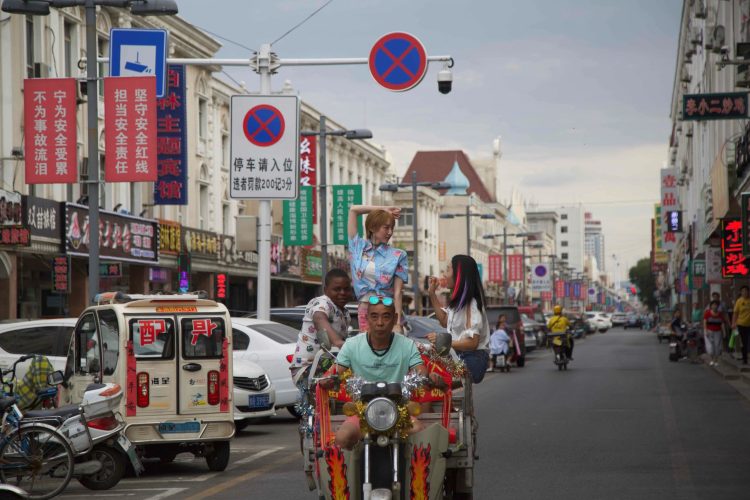
The need for self-expression through freestyle dance is irresistible to many living on the margins of Chinese society. Teng Yuhan recalls that when she went to film Pink Hair’s crew dancing at West Square near Zhengzhou Railway Station, a homeless man wearing an army hat suddenly appeared and started dancing and laughing. Since Pink Hair was his friend, the homeless man invited the dancers and the film crew to the place where he lived—an open basement underneath the train station. This real-life encounter led Teng to add an episodic character of a homeless man to the script. She likens him to a god of dance living underground, going outside only when called by the sound of Pink Hair’s music blasting from loudspeakers.
Teng romanticised her experiences and observations during pre-production and shooting, perceiving Zhengzhou’s three rival ga-dance crews competing for territory and fans as factions from classic Chinese novels The Water Margin and The Romance of the Three Kingdoms. Gagaland is also marked by references to films directed by masters of art cinema. The scene featuring a giant iPhone resembles the monolith from Stanley Kubrick’s 2001: A Space Odyssey. The intentional low quality of the special effects and the romanticism embedded in Gagaland’s storyline feel akin to Nobuhiko Obayashi’s Hausu.
Teng Yuhan turns Kuaishou aesthetic and videos made by livestreamers into cinematic material. Instead of assuming the position of a livestreamer, she remains a filmmaker, referencing texts recognised and celebrated in the history of literature and cinema. Kinetic energy bursts from every frame of the film, attempting to exceed the limitations of the screen, yet Gagaland is still shot horizontally. The camera is directed at the dancers rather than being taken over by them, as it would have been had Teng followed the livestreaming format and allowed more space for experimentation and improvisation.
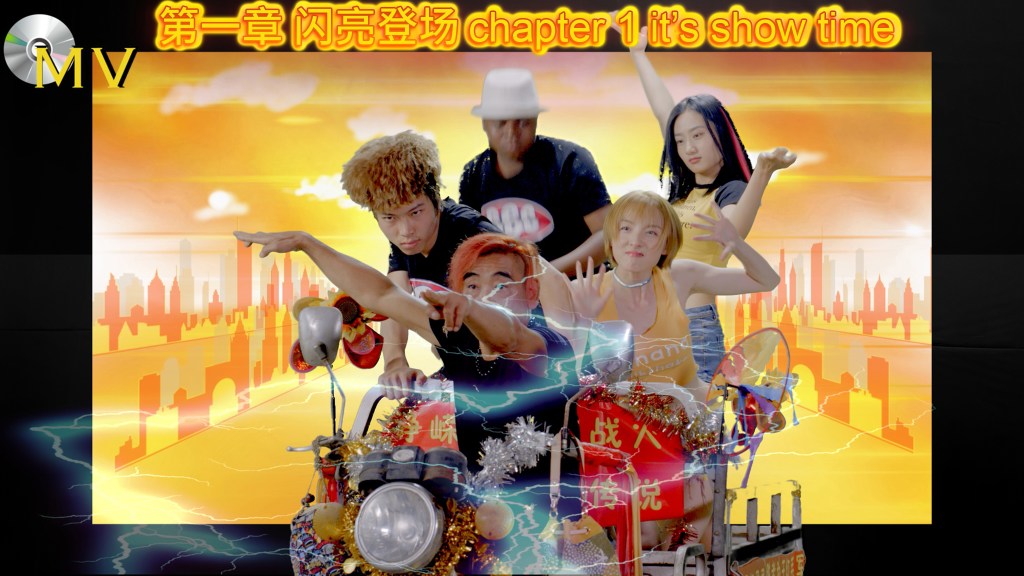
All the characters in Gagaland are modelled after real-life individuals, but the cast was sourced online through an advertisement posted on Douban. Pink Hair is the only one hailing from Zhengzhou’s ga-dance scene, and his appearance does stand out from the rest of the performers, who were selected to fit specific archetypes: the main character is slim and handsome, his love interest is blond and ethereal, the sidekick is slightly overweight, and the second girl in the group is black-haired and projected as “the big sister.” These cliché storylines are often reproduced in videos posted on Kuaishou, but Teng does not reflect on them critically; instead, she retains a positive bias toward the content on the platform, a result of her experience as a fan. Teng started working on Gagaland when she was 18 years old; she wrote lyrics and performed some of the hǎnmài songs[1] featured in the film. She also made a cameo as a nurse in one of the scenes.
The DIY spirit that springs from fandom makes Gagaland a patchwork project made out of passion. While talking with the audience after the film’s world premiere at the International Film Festival Rotterdam, Teng Yuhan was very cautious about ga-dance’s reputation as lowbrow and in bad taste. Gagaland tells as much about Zhengzhou’s ga-dance scene as it does about the troubled relationship between local grassroots culture and intellectual elites, who remain simultaneously fascinated by it yet reluctant to allow the former to take the reins in the creative process.
[1] Genre of music called “shouting to the microphone” (hǎnmài 喊麦) originated in the nightclub culture in the third- and fourth-tier cities and rural areas in the Northeast of China at the end of the 20th century. It is characterised by MC shouting lyrics over melodies downloaded from the internet. Gagaland soundtrack features songs by Panmalon Jon who, due to his characteristic singing off-key and rapping off-beat, rose to fame in 2014 with the song “My Skate Shoes”.
 sailuluo 赛璐珞