
Back in late January 2023, during the first on-site post-pandemic edition of the International Film Festival Rotterdam, I interviewed Sohn Koo-yong, whose second feature Night Walk screened in the Harbour section of the festival. For many people, it was overwhelming to be back among crowds again—sitting in a cinema or gathering at IFFR’s regular bar, WORM. It was also the last year the press office was located on the third floor of the IFFR festival centre, de Doelen—a white, bright, and spacious area that I now deeply miss since the festival centre was restructured.
Our memories and emotions are often tied to the physical spaces we inhabit, to how we feel within them. Night Walk is just about that. It is a landscape film that sheds narrative in favour of evoking a particular mood—an attempt to capture an impression of a place at a specific moment in time.

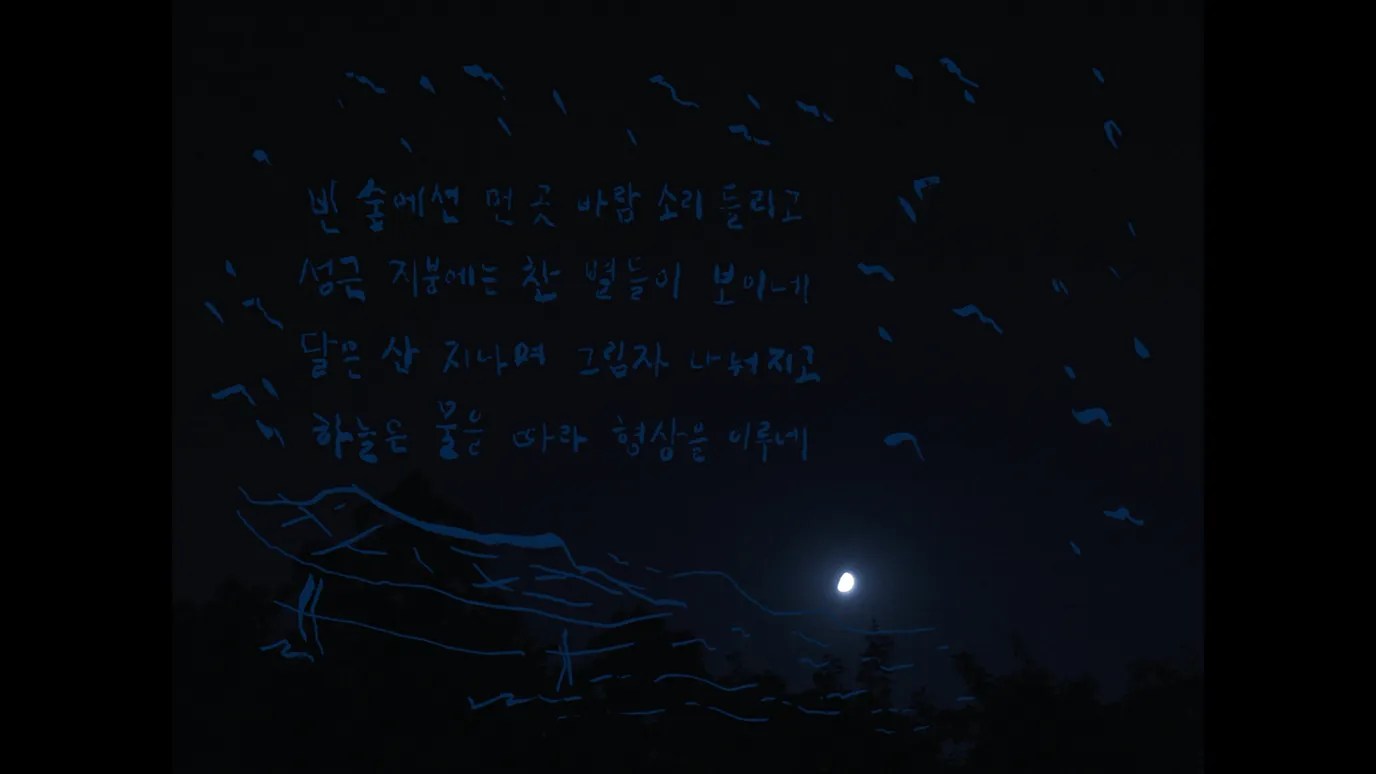
Maja: Let’s talk about the visual side of your film. I was very taken by the drawings in the intertitles, which give the film a unique and cohesive style. They create this feeling of anticipation—of getting up at night and sensing that something interesting is happening outside. It’s like a calling. I was wondering, why did you choose the color blue? Was it to evoke the night?
Koo-yong: There were two reasons. The first is a practical one. Initially, I wanted to shoot in black and white, but I also had the idea of superimposing drawings and text. My previous film was also a landscape film, but it was shot during the day. That was the first time I used text and drawings as intertitles between shots. This time, though, I wanted to blend the intertitles and the image together.
I realized that if the film were in black and white, the drawings would have to be white, and that didn’t look good. So, for practical reasons, I decided to tint the image so that the drawings and text would blend harmoniously with it.
But the more important reason is emotional. The idea for the film came from a certain feeling I had before shooting. I often take walks in the neighborhood that became the film’s location—it’s not far from my house. Along the road, there’s a stream that flows from underground. It’s hard to describe, but one night, as I walked along the stream, I saw the water—the indigo-blue hue of the water, the night sky, and myself in between. I felt completely at one with the water and the sky. It wasn’t something logical—it was purely a feeling. From that night on, the color blue stayed in my mind. The emotion I had was as if the whole world was tinted in dark blue.
Maja: It’s very interesting, because when we think about the cityscape—and just walking at night—it’s usually yellow, illuminated by the streetlights. The neighborhood where you shot, Segeomjeong, is it a residential area?
Koo-yong: Yes, it is. The popular image of Seoul in the media makes it seem entirely metropolitan and modern, but it’s actually not like that. There are many small neighbourhoods such as this, and the city itself is surrounded by mountains. I think it’s one of the most mountainous cities in the world. Segeomjeong is located just above the main downtown area, but because it’s enclosed by mountains, it feels quite suburban and quiet. The natural landscape—the mountains and the stream—probably dominates more than the urban scenery.

Maja: I was curious about the visual stillness in your film. The shots are so steady and composed—how long did it actually take for the camera to be there?
Koo-yong: It was there for quite a while. I really take my time shooting because I develop the narrative structure of the film as I go. This one was filmed from spring to fall—about five to six months, all in the same neighborhood.
What you see in the film is probably less than ten percent of all the footage I recorded. For example, if a shot in the film lasts ten seconds, I didn’t just shoot for ten seconds. The camera would stay there for a long time, and I needed to feel its presence with me. Even if there’s no movement, the camera has to settle into the space.
In Korean, the word for filming a scene is composed of two characters meaning to gather and light. It captures the essence of what a camera does—it collects light. Even though I work digitally, it’s still about gathering light. So even if a shot ends up being ten seconds long, I might stay there for half an hour. I need to feel that process, to sense what the light is doing.
Maja: “Shooting” feels external and obviously has a connotation to violence, while “gathering light” is a process that goes inwards. How did you decide where to film?
Koo-yong: While shooting, I was already thinking about how the sequence might come together in editing. But during the edit, I was also drawing, and I wanted to create a kind of rhythm—a visual rhythm that moves in and out, between wide shots and close-ups. I didn’t want it to be repetitive. The timing and pacing had to vary. Maybe it’s instinctual.
Maja: So there wasn’t a fixed logic to it. It’s also fascinating that gathering light at night must have been so time-consuming—there isn’t much light, apart from the moon. Did you ever meet people walking around while you were shooting?
Koo-yong: A few, yes, but it’s a very quiet neighbourhood. I was mostly shooting late at night, so there weren’t many people around. From the start, I didn’t want to include pedestrians in the shots.

Maja: The history of this place is fascinating. There’s a strong Confucian tradition associated with it. There was a chronicle of scholars who observed the compilation of the Veritable Records of the Joseon Dynasty. So, it’s the same stream?
Koo-yong: Yes, it’s the same one. Of course, I’m aware of that history, but I didn’t want to emphasise it. Often, landscape films are linked to a director’s attempt to connect the scenery with historical or political meaning, and I wanted to move away from that. My main impulse came from a sentiment, a feeling. I wanted to express that sensation the way one might in painting or music. Kristina Aschenbrennerová, who programmed Night Walk at IFFR, described it as a “visual song,” and I felt that was the best way to describe the film.
Maja: I can see that. Watching the film was very soothing—it felt like a good rest for the nervous system.
Koo-yong: Regarding the scholarly background—they’re called seonbi. The texts in the film come from anthologies written by them. In fact, one or two of these scholars often visited the area that is now Segeomjeong. During the Joseon period, many seonbi had the habit of retreating to the mountains. It’s not in the film, but there was once a villa in the mountains—of course, it no longer exists, only the stones remain. It’s one of the few places in Seoul that can still be considered a genuine historical site, with remnants of the original structure.
Maja: I also wanted to ask you about the class issue: seonbi being the educated class. I was wondering what their place is in contemporary Korean culture. How are these traditions reflected today?
Koo-yong: Well, my main motivation when making something comes from the fact that contemporary Korea is very detached from tradition. You might know this, but after the Korean War, our whole society began looking only forward—striving to become richer and richer. Nobody looks back. And I think that’s a very bad thing.
Whenever I travel abroad, even in Japan, I feel that there’s an accumulation of time—society, politics, everything layers upon itself. But in Korea, we just forget yesterday and keep moving forward. And in my opinion, artists and filmmakers rarely talk about this. That’s really my main drive: to look back. Especially for Koreans, I think we should just stop for a moment—look back, or look sideways. Stop constantly moving forward when we don’t even know where we’re going.
That’s the main reason I included the Joseon poems. Nobody reads them anymore. From my research, of course, the seonbi were part of the elite—they worked for the government—but many of those still remembered today were the ones who went against power. They left Seoul for the countryside or the mountains to teach. They were mainly educators, spreading Neo-Confucian ideas to the people.
Of course, this didn’t reach the lower classes. And regarding your question—how it’s linked with contemporary Korea—in my opinion, there’s no real link. Politicians don’t know, nobody talks about the seonbi. Only a few scholars or researchers do. Even in school, these poems are barely read. Maybe a little bit in high school, but it’s not central. The main goal, as you probably know, is to get good grades and enter a good university.
Maja: The anchor of the film is a walk, yet visually it’s composed of static shots. Could you talk a bit about that choice—to use fixed frames instead of panning or a handheld camera?
Koo-yong: It’s really hard for me to find a reason to move the camera, especially when there’s no person in the frame. If a shot doesn’t include a person, any camera movement feels very artificial to me—even though the film is about walking. In my previous film, I followed an actress on a walk; she was, in a sense, playing me—walking through the neighborhoods. But this time there’s no actor. Each shot represents my own perspective. In that way, perhaps it allows the audience to feel as though they’re walking with me, seeing these places through my eyes.
Maja: I also wanted to ask you about the drawings. When I was watching the film, I thought of Feng Zikai, the illustrator active in 1930s Shanghai.
Koo-yong: Yes, the tradition of literati painting—art created by scholars—goes back to ancient China. In Joseon, though, it took on a slightly different character. The essence of literati painting, I believe, is not the depiction or representation of the outer world. Of course, it features flowers, mountains, and landscapes, but the painters didn’t objectify them—they didn’t treat the mountain as a separate subject. They were attuned to nature. What they painted was not nature itself, but themselves in communion with it.
This interaction with nature was not through the senses, but through the heart. There’s a term—마음 (ma-eum)—which means “seeing not with the eyes, but with the heart.” It’s about dissolving the boundary between oneself and the external world. It’s a kind of inner vision. That’s what I wanted the film to express—this inner vision. Although the camera records what I choose to frame, it also, in a way, captures me behind the lens. It shows that the landscape can exist not only outside us, but also within our inner world.
Maja: I’m guessing that’s also why you didn’t use any music?
Koo-yong: Well, actually… at first, I recorded all the sounds very meticulously. But during the editing process, the soundscape began to feel unnecessary. It’s a very difficult decision to make a silent film in this era, but once I removed the sound, it suddenly worked. Perhaps it relates to drawing attention inward—to the inner world. And when you think about it, our environment today is so polluted with noise. Sometimes, while walking, it feels good not to listen to anything at all.
Maja: It was also interesting how the intertitles—their typography and placement on screen—follow the conventions of silent cinema. Was that reference intentional? Or was it more connected to poetry?
Koo-yong: Of course, I thought about silent films—their simplicity and visual purity. I think they represent a purer form of cinema. But I didn’t consciously model Night Walk on silent film conventions. In many landscape or experimental films, there’s narration or voice-over, but I wanted to take a different approach. I felt I should strip away everything unnecessary—anything that this specific film didn’t need. That meant removing the voice-over, the actor, and even the plot. I simply wanted to make something very simple.
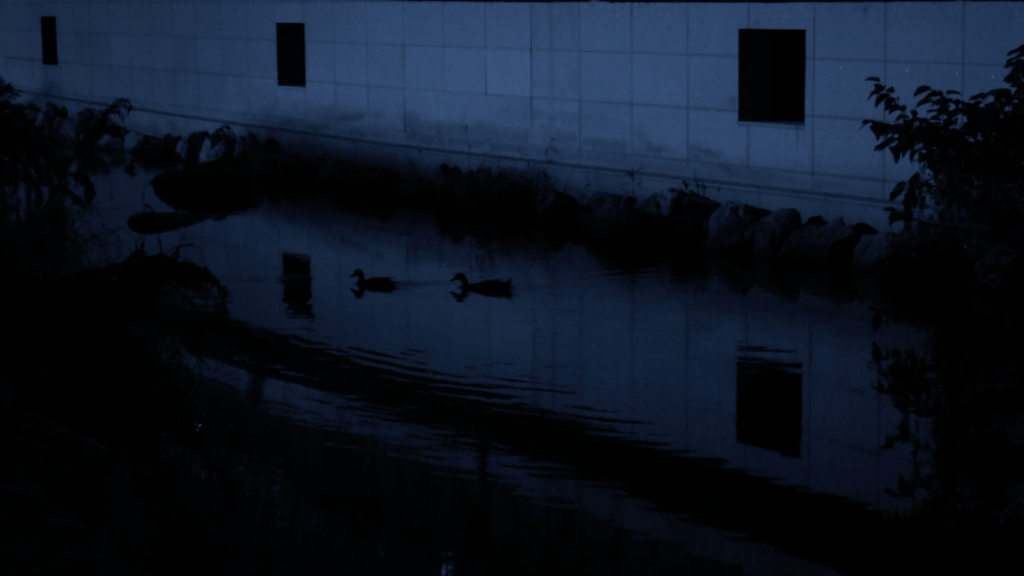
Maja: There are still actors, though—a cat and some dogs. In terms of narrative, it feels like the story of going out and coming back home. How did you choose the poems and match them with the images?
Koo-yong: At first, I wanted to write the text myself, maybe in the form of a diary. I was cautious about using poems because I didn’t want them to take away the poetic quality that should come from the images themselves—not the drawings, but the pure images. Eventually, I decided to use the poems because, although they are separate works, together they tell a story.
The poems at the end of the film speak of the moment when morning arrives, while others describe the passing of the seasons. The shooting took place from spring to autumn—it’s perhaps not immediately visible, but I wanted to create a sense of narrative through the poems. Initially, I selected them based on how they spoke of the night. Many of these poems praise the moon and the moonlight. In the Eastern tradition, the moon is not something to be conquered, as in the Western imagination of astronauts; it’s something that reflects one’s inner world—the moon within the heart. The literati wrote about that idea, and it connected naturally with the shade of blue I had felt.
Maja: That’s interesting, because in Chinese poetry—take Li Bai, for example—there’s an image of reaching for the moon reflected in water, which became the saying 海底捞月 (“to fish for the moon”), meaning to attempt the impossible.
Koo-yong: Yes, I think I know that poem—Li Bai.
Maja: He often wrote about the moon. I think he drowned himself—he loved drinking, and one night he fell into the water and drowned.
Koo-yong: Is that a legend, or is it true?
Maja: I’m not sure, maybe it’s half and half.
Koo-yong: So, you know a lot about Chinese literature?
Maja: I don’t really know much about poetry. I’m generally very interested in language—how sayings create images, and how they shape one’s perception of the world, of humans and their environment. When it comes to the poems in your film, actually, at some point—because I’m a very slow reader—I stopped following the text completely. And somehow, I enjoyed that even more: catching only fragments of words, or simply looking at the typography. In that way, it became an even more integral part of the film for me. It’s a different kind of perception, but it felt very good that the film didn’t try to impose all the information on the viewer. It just invites you to observe. Do you already have an idea of what you’d like to do next?
Koo-yong: I have a few in mind. It will also be about a landscape, but I’ll try to approach it differently.
 sailuluo 赛璐珞