

During the CinemAsia Film Festival in 2025, filmmaker Truong Minh Quý presented his feature, Việt and Nam, to audiences in Amsterdam. It was an unexpectedly warm early March in the Netherlands when we sat down in the festival office near Studio K to talk about the film, almost one year after its premiere at the Cannes Film Festival in 2024. I had seen the film a few months earlier and rewatched it in preparation for the interview. I was curious how the film would affect me after some time had passed. I must say, it is not a film to be watched in between other screenings at a major film festival. While seeing it at the Busan IFF was a memorable and powerful experience, I felt somewhat sad that I didn’t have enough time to reflect on it as it deserves. However, at a film festival like CinemAsia, which is dedicated to local audiences, there is space to breathe, think, and talk about the film. Truong Minh Quý was a very generous interlocutor. Despite having been interviewed multiple times since the film’s premiere, he avoids repeating the same answers—as if the film is now its own being, with its own history.

Maja Korbecka: Việt and Nam has been traveling the film festival circuit for a year now. How has your attitude toward the film—or your understanding of it—evolved over this time?
Truong Minh Quý (TMQ): I think there have been many changes. The film started its journey in May last year in Cannes, and just before that it was banned in Vietnam—which, to be honest, I don’t think should overshadow the conversation around the film. But I also can’t avoid it, because it has become something people immediately associate with it.
At every festival, the film is introduced as “banned in Vietnam.” Audiences always ask about it—why it was banned, how it was banned. So I can’t escape that; it’s become part of the film’s history. The beginning of this journey was emotionally overwhelming, because everything happened all at once.
But now, after all the festivals and the release, I think I’ve learned a lot. I’ve learned to accept different opinions about the film. And I’ve also learned how to look at the film in a more innocent, fresh way—almost as if I were back at the beginning, before it was even shot.
What sort of feedback have you received from audiences that surprised you?
TMQ: This film occupies a strange position. For me, one of the main reasons for making it was to let go of the dominant narrative of Vietnam. I think both audiences inside and outside Vietnam already have a set image when they think of Vietnam—usually war and landscapes.
For me, filmmaking is a spiritual process. There’s this enigma I’ve always felt I had to solve—the enigma of “Vietnam” as a narrative. As a filmmaker, how do I deal with that? How do I work with this narrative, which is so ingrained in the history of cinema and art, while also responding to it?
At the same time, I wanted this film to be about releasing that burden—the burden of history. That’s why, in the film, you see a directness in many aspects: in the way it approaches the war—or rather, the wars—because there are many, and they’re often unnamed (in the film). I wanted the audience to be free to connect each scene with whatever war or wars they wanted.
This directness also applies to the love story in the film, and to how the characters express emotion. There’s something very lyrical and transparent about it.
Even the title—Việt and Nam—is a way of calling something by its name, of facing it directly, and then letting it go. For me, the film is quite open emotionally, and it’s really about a spiritual journey—trying to solve a spiritual question.
But what surprised me is how differently audiences reacted. The Vietnamese authorities banned the film because of the English-language title – “Việt and Nam.” That was unexpected. They saw the title as offensive. Overseas Vietnamese audiences, on the other hand, have very different political backgrounds. So for some of them, the title made them think the film was a propaganda piece, and some refused to watch it.
So the film is just there, standing independently in the sunlight, so to speak—and it’s fragile. People project onto it depending on their political and historical backgrounds. Each person sees it through their own lens. I’ve also received feedback from overseas Vietnamese, especially in France, who told me the film made them feel homesick. Some haven’t returned since the 1970s, and they told me it made them want to go back.
But of course, I’ve also had some not-so-positive responses, especially from Vietnamese audiences who are politically motivated in a different way. What I’ve learned is that I now need to maintain some distance from the feedback.
Some people see me as a kind of messenger or representative of Vietnamese cinema or history. But I’m not comfortable with that. It’s not a position I ever wanted. I’m just a filmmaker. I decided to tell this story in this way, at this moment. And in the future, I’ll move on.
MK: I heard you’re working on a new film. What is it about?
TQM: It’s a documentary I started shooting more than two years ago, before Việt and Nam. I’m co-directing it with Nicolas Graux, my partner, who’s also a filmmaker. It’s a documentary in the form of a home-movie film. Something like what Jonas Mekas did.
We shot it with vintage Bolex cameras on Super 16mm. The technical nature of this camera really shaped the film. The frame rate is unstable, very fleeting. Each rolling lasts a maximum of about 30 seconds, and it’s hand-rewinded so everything is manual. That constraint created the style of the film.
MK: So each scene can only last about 30 seconds before you have to stop and reload?
TMQ: Yes, exactly. We have to stop, wind it up again. That’s how it works.
MK: Will it be a full-length feature?
TMQ: It’s around 70 minutes now. I think that’s a good duration—not too long. We’re in the final stage of editing.
MK: I’m really looking forward to seeing it. It sounds lovely. What’s it about?
TMQ: It’s mostly about how we see the beauty of life—flowers, children playing.
MK: Did you shoot it in Brussels?
TMQ: No, in Vietnam.
MK: Can you still shoot films in Vietnam? Could you make another film with new footage there?
TMQ: I have to be more cautious than before. I think my name is now known infamously. I never wanted to be visible to the system, but it happened.
That said, we’re independent filmmakers, so we know how to work around these things. For example, I don’t have to have my name on the official paperwork for the shoot. Or I could use a pseudonym. And often we just say we’re making a documentary—authorities tend to think documentaries are harmless, so they don’t pay attention.
MK: For me, it was mind-blowing because it reminded me of Yellow Earth and what it did to the global image of Chinese cinema.
TMQ: I like Chen Kaige’s films more than Zhang Yimou’s or the others. There’s this darkness in them, you know—something wise but also something corrupt in the characters. His films are heavy. I like that—they’re not just beautiful like Zhang Yimou’s. Maybe I should have called the film “Blood Earth” (haha).
MK: I think “Việt and Nam” is perfect because it evokes the division between the South and the North.
TMQ: For me it is not a division as such. It’s like, I keep using this metaphor—when we stand in front of a mirror, we see the reflection of our face in the mirror, there are two faces but they are one at the same time. So Việt and Nam, for me, are like a mirror. It’s not something to connect or separate—it just reflects.

MK: One of the things that really grabbed my attention in the film was the idea of colonialism—or rather, what contemporary colonialism means. Choosing to go to another country as if that’s the only good way out of poverty. I was wondering how you see the connection between the film and colonialism?
TMQ: I think the film definitely has a strong historical foundation. It all goes back to war, and to how we perceive different wars in relation to what’s happening in the film.
But at the same time, I wanted everything to be abstract. Even the destination of the characters—the country they want to go to—it’s never named in the film. Same as the characters’ own names. We don’t really know who they are.
Because when we talk about immigration, if we only rely on what we read in newspapers or in interviews with real people who immigrated and returned, then yes—we hear that the main motivation is to earn money to send home. But not all of these people are poor. Some come from average families, even well-off ones.
So the motivation to leave is not just economic. There’s something deeper. Maybe historical. And the film tries to make that connection. I think the audience can make those connections—or not. But in the film, I never answer the question “why.” Why do they want to go?
Because I think, first of all, we shouldn’t have to justify why we want to go somewhere else. But also, due to economic and political reasons, for some countries it’s incredibly hard to travel. Even just to travel requires huge preparation—sometimes half a year in advance. And in this case, it’s not just travelling. It’s gambling with your life.
So the film doesn’t answer the “why.” That question is too vast. And for me, not the most important. What matters more is how to create interconnections between migration, history, and memory. So the character lives in between. He carries the history of his family, who have a direct link to war, and now he himself is migrating.
Also, I think this film contains many wars—not just the American war in Vietnam, which is the most obvious one, because of how Hollywood shaped our collective knowledge. Whenever we talk about the war in Vietnam, people immediately think of American movies.
This film makes references to that, even visually in some scenes. But it also references the Vietnamese propaganda war films. It uses cinematic language to refer to different cinematic and historical backgrounds.
And the film also implies other wars—not directly, but they’re there. Like the war between Vietnam and the Khmer Rouge. There are many scenes that imply different historical moments. Always unnamed, but present.
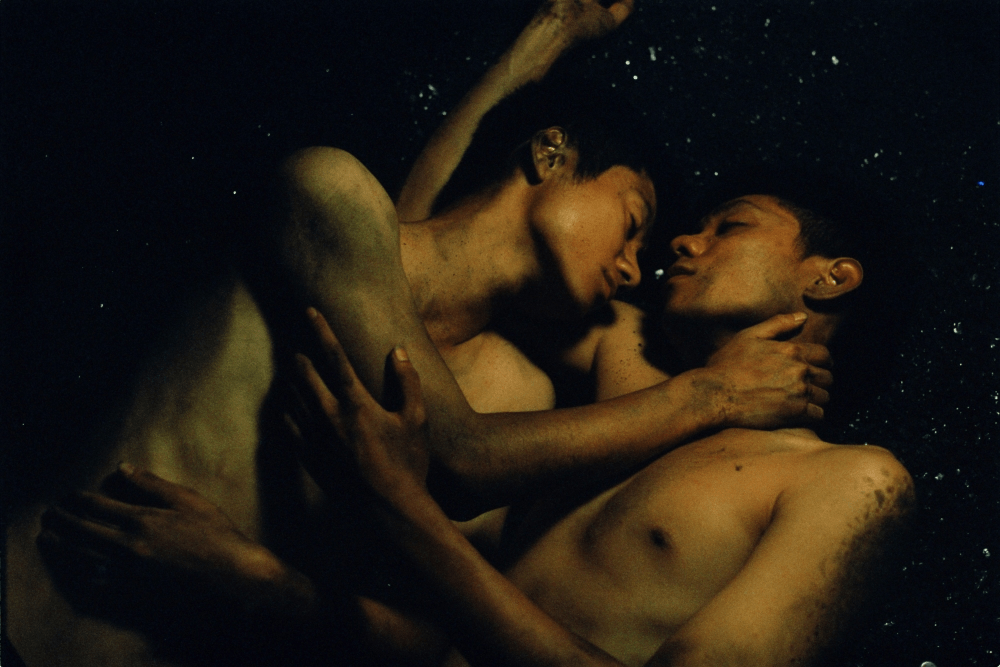
MK: When I was watching it, what really struck me was how you use the color black. It’s a very subjective impression, of course, but when I was in Vietnam and visited temples, I remember them being very, very black—especially compared to temples in Taiwan or China. I was wondering about your use of black. I mean, obviously, there’s the association with coal mining, but beyond that, blackness seems to create a very strong character for the film itself. What does it mean to you?
TMQ: I think it’s very important. First of all, for the audience to be immersed in such darkness is quite unusual—and maybe even uncomfortable. Some people might feel it’s too dark.
But for me, it’s essential. First, of course, it’s the environment. Coal miners work every day underground. If you actually go into a coal mine, you’re completely immersed in darkness and silence. It’s like being stuck in a sound recording studio —but without light. What you see is only what’s within the small lit zone of the tunnel.
You feel very suffocated. It’s a completely different world. But because of that limitation, there are certain forms of beauty that you can’t see when it’s too bright—like the floating coal dust, the way it sparkles.
So in this film, I use darkness, of course, as something metaphorical—as a way of giving space for imagination. In the darkness, the audience can imagine more. They can picture the two lovers floating in a starry night, for example.
But the darkness is also historical. It’s the darkness of unsolved questions, of memory. There are many questions in the film that are never answered. And I think darkness can carry a kind of weight—a heaviness that is important to feel through watching.
And of course, when we talk about film, we also have to consider practicality. Artistic choices must align with the reality of making a film within budget. In that sense, darkness is very practical. You don’t have to show everything.
MK: I can imagine that it must have been very difficult to shoot with that kind of lighting.
TMQ: Yes, but it had to be like that. Otherwise… Well, if this was a Hollywood film, we would see everything—even inside the coal mine.
But here, I took inspiration from the real environment of underground coal mines. And that inspiration also helped us with the budget, because we only needed to light what the audience needs to see. Some scenes were shot in a studio, and we only lit specific areas. Other scenes were filmed in a real cave, which we transformed into a coal mine.
If we followed the Hollywood style of lighting, we would have had to construct everything from scratch. And the result wouldn’t be right for me, because when people see that kind of lighting, they know it’s a movie. But when people watch this film, the first thing they feel is that it’s suffocating, it’s dark—like being in a black hole.
That layering between darkness and light also creates something dreamlike. Though that wasn’t my intention, some people ask me, “Was it a dream?” Like in the opening scene, where the boy retells his story. But for me, everything is real. And I think reality already contains that dream-like quality. It can happen by accident, through editing or even just through atmosphere—it becomes obvious.

MK: I also noticed that the film is a huge co-production. Was it difficult to communicate with all the producers and maintain your vision? Did anyone try to interfere?
TMQ: Luckily, I didn’t encounter any conflict between the producers and my choices as director. I think I was fortunate. I was also lucky to work with a crew of about 50–60 people for 45 days.
From the outside, it looks like a massive production—eight or nine countries involved. But actually, this is pretty standard for independent films from Vietnam or similar countries where there’s no national film funding. So we had to piece by piece find money from different countries. Some gave very small amounts, some a bit more—and each one wanted us to spend their portion of the budget in their own country, in one way or another.
That’s a whole separate issue. This model of international co-production is helpful, of course, but it also comes with problems. For example, this film—if it were made in France, with the same scale and length—it would be impossible to make it with the same budget. It would cost three times as much, but with half the shooting days.
So when people watch this film and see that it’s shot on Super 16mm, with 45 shooting days, and multiple locations all over Vietnam, they might assume it had a huge budget. But no. It was only possible because we shot it in Vietnam (with the understanding and support of the crew, too). So there’s also a question of fairness in the global economy of filmmaking. I don’t have an answer to that.
MK: During the shoot, did you change the script in any way? Or was it exactly as it was written?
TMQ: I had a script before the shoot, of course. But I made many changes during location scouting and casting. Not so much during the shoot, but in pre-production.
For example, the older man who plays the veteran—he’s a real veteran. He shared his own memories with us. That changed the confession scene. So the final version is different from what was written.
And when I found the right locations, the characters’ actions had to change accordingly. Small things. But important.
MK: Maybe this is too personal, but—what do your parents think about the film?
TMQ: They haven’t seen it yet. I haven’t had the chance to show them in the right setting. They don’t live in Ho Chi Minh City (Saigon), where I organized private screenings for friends.
But at the beginning, when some news came out saying the film was banned, my mother asked me, “Is your film anti-state?” I told her, “No, it’s not. Don’t believe what you read in the media. They haven’t seen the film.”
MK: I hope you’ll get a chance to show it to them properly.
TMQ: Of course I could show it to them on my computer, but I don’t want to. It’s a totally different experience.
MK: I first saw it in a cinema in Busan, and then again recently on my laptop—and it’s just not the same.
TMQ: Exactly. I think it’s very important for a film like that, even if it’s just in a small screening room. My parents could sit down in the dark with others. If they just watch it on a laptop, they won’t focus. They’ll laugh or ask me questions in the middle. But if they’re in a cinema—maybe they can see others praising their son and then they’ll think, “Okay. Maybe this film isn’t bad. Someone liked it.”
 sailuluo 赛璐珞