
On a sunny morning sometime in early April in Amsterdam, I met Singaporean filmmaker Tan Siyou who was showing her debut feature film Amoeba at the CinemAsia Film Festival.
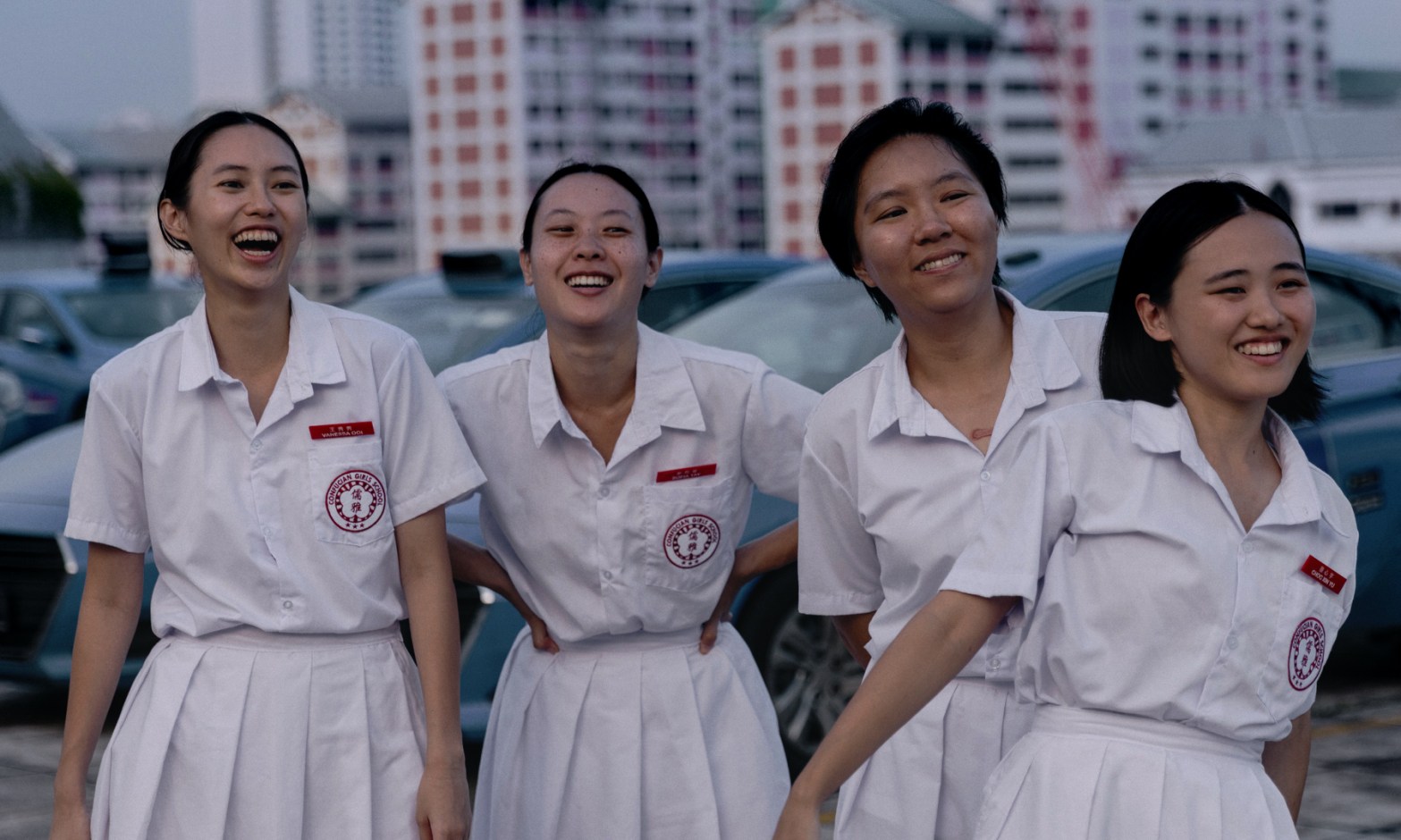
Amoeba focuses on the misfit teenager, Choo, in a conservative, elite Chinese-language high school in Singapore. After being transferred, she befriends three classmates of different social classes but equally critical of school as an oppressive institution. They bond over the shared worldview and form a gang, but the social structure and future choices inevitably tear them apart.
Tan Siyou discusses the function of the camera within the narrative, teenage desire, Singaporean society, and exhibition and reception of the film in Singapore, China, Taiwan and worldwide at film festivals.

Maja: At the time we first met in Berlin in 2022, you were still looking for co-producers for Amoeba. It’s a huge co-production, with five countries involved. After the release in Singapore, do you already have information about distribution in the countries of the co-producers?
Siyou: Besides Singapore, we also sold the film to the Netherlands. Yesterday I met my co-producers and they told me the film should come out in cinemas here in July.
Maja: That’s perfect timing for the end of the school year.
Siyou: Exactly. Then the kids can go see it.
Maja: In Singapore, though, teenagers and university students won’t be able to go to see it in cinemas, because the film got the rating P21 from the board of film censors. Maybe they might be able to watch it online?
Siyou: I think it’s sad because university students especially really want to watch it. Of course it’s unfortunate they can’t see it properly in a cinema with good sound and projection. But there’s also something interesting about this underground feeling. And honestly, it’s very moving for me to see how badly teenagers want to watch the film. Some of them told me they bought tickets but got turned away from the cinema because of the age restriction.
The multiplexes didn’t really want to take Amoeba. I think partly because of the 21 rating. It limits the audience and also restricts the screening venues. On top of that, it’s considered a sensitive film. So only the new Projector, which is now called Filmhouse, agreed to screen it. Honestly, I’m happy about that because I love that space. It’s independent, it’s in an old building, and it always felt like a dream to have a film shown there.
Maja: Is it still in Golden Mile Tower?
Siyou: Yes, same place. New management, new owner, but essentially the same cinema. I think they even kept a lot of the staff.
Maja: I was also wondering: did you ever consider another title besides Amoeba?
Siyou: For the English title, yes, but eventually I couldn’t think of another title that felt right. One of my mentors in Torino suggested naming the film after the gang in the story. He said that maybe Amoeba wasn’t attractive enough as a title. A lot of people told me it sounded too scientific or too abstract, that it didn’t immediately communicate what the film was about.
But after thinking about it for a long time, I realized I really wanted it to be called Amoeba. I think when I was growing up, I felt like an amoeba myself. There’s something about shapelessness and formlessness that felt important to me. Also the connection to water in the film. And the fact that amoebas are invisible to the naked eye—it relates to the ghosts and invisible presences throughout the film. The whole film is about things that cannot be seen but are still there. So even if it wasn’t the “sexiest” title, I felt it was the right one.
Maja: I actually think it’s very memorable. Especially at film festivals, where many titles—particularly for mainland Chinese films—are long and difficult to remember. Amoeba is very evocative.
Siyou: I’m happy to hear that. During development, a lot of people told me not to use it. But it was one of the few things I felt stubborn about. And what’s interesting is that audiences really seem to understand the title in their own ways. People come up to me after screenings and say, “I felt like an amoeba too.” In Singapore especially, several people told me that growing up they also felt this strange shapelessness.
Maja: There were many elements in the film that resonated with me deeply. Even the idea of the amoeba itself—there’s a kind of self-sufficiency to it.
Siyou: Yes, exactly. It’s tiny and strange, but independent. I really like that. Especially when you’re growing up in an environment that doesn’t necessarily feel friendly. Particularly in high school.
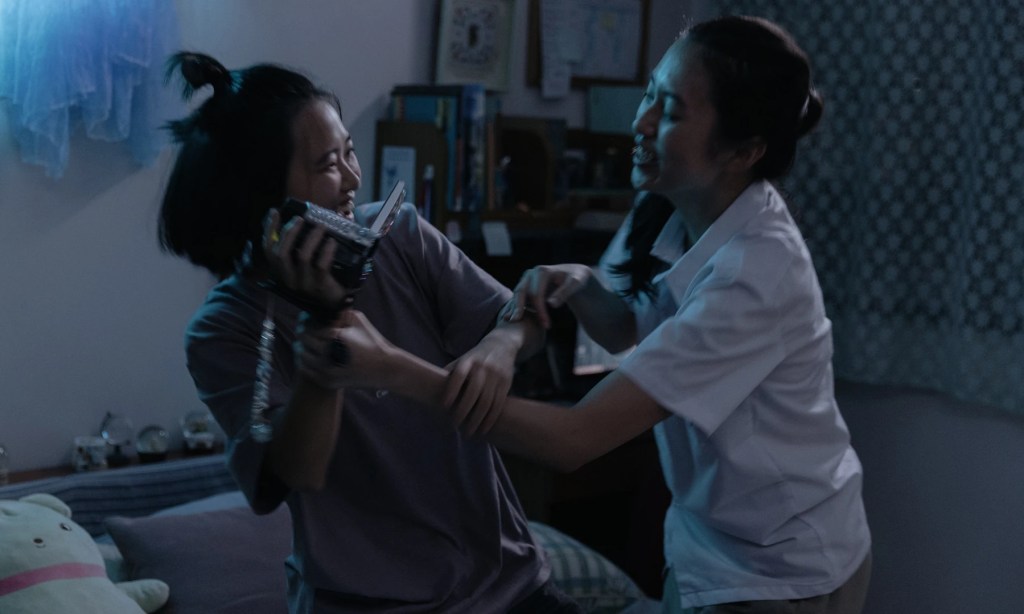
Maja: I also connected strongly to the presence of the digital camera in the film. In high school I was always the person filming everything—making little music videos from summer footage or recordings from the last day of school. And I also went to a Catholic high school with uniforms and strict rules, so there were many things in Amoeba that felt very familiar. What do you think makes the camera so appealing for teenagers?
Siyou: I actually didn’t grow up with a camera myself. There was always another friend in the group who had one. Sometimes I feel jealous of people who say, “Oh, we have family archives of videos from when we were children,” because my family never really cared about documenting things like that.
It was only much later, maybe when I was in college, that I started watching more films and became interested in film photography. That’s when I bought my own film camera and began taking pictures. And I realized something: I liked being behind the camera because it felt safe. The camera creates a distance. You’re part of the world, but slightly protected from it at the same time. I also like recording things because my memory is not very good. So for me, cameras became a way of preserving moments and people.
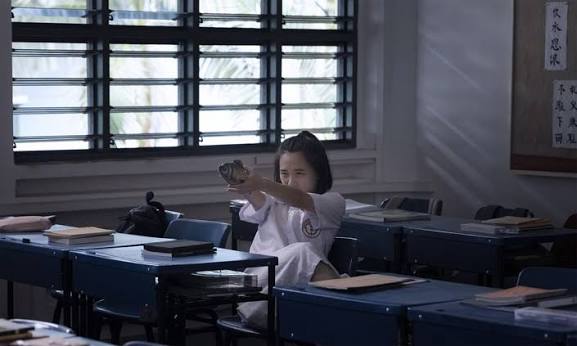
In Amoeba, I use the camera to show Choo’s position within the group. She belongs to the group, but she’s also slightly outside of it. She’s the new girl, she’s different.
The camera also becomes a way for the girls to reclaim an old object that adults no longer value. In Singapore, I often feel that old things are discarded very quickly. There’s always a focus on the new: new buildings, new infrastructure, new development. So the camera becomes a transmission object. The girls pass it between themselves. It’s their way of immortalizing themselves and gaining some agency in an environment that doesn’t really allow much of that.
Maja: There’s also that scene that’s very sexually charged, where the camera is literally at the center of everything. I was wondering whether you intended that scene to remain elusive—or whether, without concerns about ratings and distribution, it might have been more explicit.
Siyou: No, I think that scene needed exactly that balance. For me it was important to capture teenage desire, but also the fear of acting on that desire. I didn’t want consummation. In my experience, teenage desire rarely reaches that point. It hovers somewhere in between. And because nothing fully happens, you continue thinking about it afterward. That lingering feeling interested me much more. So the scene is really about this spark of desire that appears suddenly and disappears just as quickly, but leaves an emotional mark.
It’s also realistic to growing up in Singapore. You’re aware your parents are outside the room. They could walk in at any moment. There’s constant anxiety.
I also wanted the camera and the girl to become intertwined. Is Choo moving closer because of attraction to the girl? Or because of the camera? The two desires become inseparable.
And I think watching someone sleep is an incredibly intimate act. Allowing someone to watch you sleep is intimate too.
Maja: When the camera goes missing later, that’s what Choo is truly afraid of—not because anything necessarily happened, but because the footage itself feels private.
Siyou: Exactly. In that environment, you grow up already knowing what you are not supposed to do. So you move around the boundaries. Maybe something happened, maybe nothing happened. But everyone knows it’s dangerous, and everyone knows they could get into trouble.
Maja: There are so many things in the film that exist between visibility and invisibility. You mentioned before that the characters are composites of different people you knew growing up. But you also said you had your own “gang” in school.
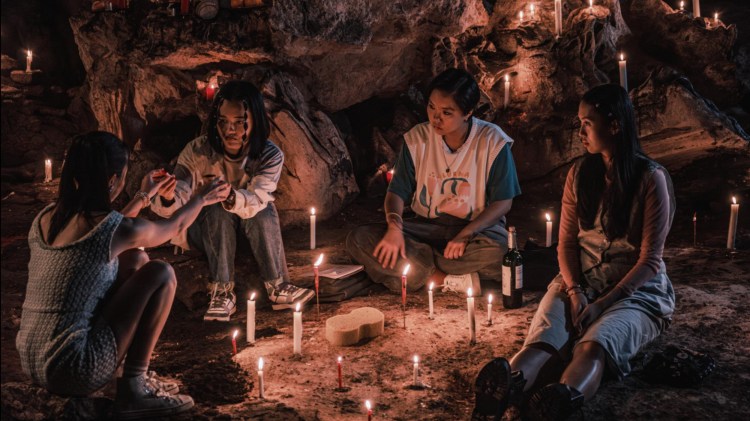
Siyou Tan: Kind of, yes. I went to a school like the one in the film. At first I had a group of friends, but I was always the one who argued with teachers. My friends would tell me: “Just keep your head down. Don’t fight back.” Eventually the teachers moved me into a so-called “bad” class full of students with poor grades and sports kids. That’s where I met these three girls. We immediately became friends. And for the first time in my life, people weren’t telling me to stop rebelling. Instead they were saying: “Okay, let’s go.” It was a very important friendship for me because it was built around resisting the system together.
At the same time, it was also this group of closet lesbians who never openly talked about it. But we all somehow understood each other. There was a very deep connection that remained mostly unspoken. After two years we all transferred to different schools, and that separation really stayed with me. We’re still close friends today, but that first heartbreak of losing a group like that never really left me. For a long time I think I romanticized those years. Teenage friendship feels eternal at the time. It feels almost like romantic love.
Maja: Did your friends recognize themselves in the film?
Siyou: Yes—and no. One of them, who is closest to Gina’s character, told me: “Art imitates life and life imitates art.” They were all very touched. And the funny thing is that I never told them I was making a film inspired by our friendship. So in a way, the film became my expression of affection toward them. After they watched it, our group chat became active again. Everyone started asking, “Who is this character based on? Is that supposed to be me?” And I kept saying, “No, no, it’s not exactly you.”
Maja: There’s something uniquely powerful about coming-of-age stories. Watching Amoeba, I was also thinking about Happyend and how both films deal with separation and the end of friendship.
Siyou: That’s interesting because I actually know Neo Sora. We went to the same school. At one point we met and realized we were both making films about friendship. I think many people connect to this moment in life when exams or educational systems suddenly separate you from the people you love.
For me, bridges in Amoeba symbolize transition. When Choo crosses the bridge and encounters the funeral procession, she’s moving toward a transformation. Teenage years themselves are very transitional. Everything feels fluid and unstable. Emotions are amplified to an extreme degree. Something small happens and it feels like the end of the world. That emotional intensity interests me a lot.
But I also think coming of age in Singapore is very different from coming of age in America, for example. In the US, adolescence is often framed as a period of discovery—discovering who you are and what you love. In Singapore, I sometimes feel it’s the opposite. It’s less about discovery and more about suppression. Growing up there, I often felt my life was part of a larger national project. Singapore is small, and everyone is expected to contribute. So coming of age becomes learning how to accept responsibility toward the collective. In that sense, it can feel like the killing of a part of yourself.
Maja: So it’s almost a reverse coming-of-age process.
Siyou: Exactly. But then groups like the girls in Amoeba become forms of resistance. That’s also why the gangsterism aspect became interesting to me. When I was growing up, there were still small groups of gangsters hanging around outside malls smoking cigarettes. But today you barely see them anymore.
During my research, I became fascinated by the history of gangs in Chinese communities. Originally, many gangs emerged as political organizations during the Qing dynasty. Their purpose was to restore the Ming dynasty. Even Sun Yat-sen had ties to gang networks. So originally these groups weren’t about crime. They were about brotherhood, loyalty, righteousness, and political ideals. That was what interested me—not criminality itself, but this longing for solidarity and collective identity.
Maja: And at the same time, the state fears people organizing together.
Siyou: Exactly. I think governments are often afraid of collective mobilization. The girls’ friendship in the film is very pure, but friendship itself can become political. Once people unite, they might begin questioning things together. That’s why the school in the film also becomes a model of the entire society.
What fascinated me when the film screened in China was how strongly young audiences there connected to it. I honestly never expected the film to screen there at all because of censorship. But somehow it passed and screened at the Pingyao International Film Festival. The response was incredible. Young audiences really embraced it.
That was very striking to me because I never consciously intended to make a film “about” China. But the structures of obedience, hierarchy, social control, and Confucian values resonate strongly between the two societies. Singapore and China have this interesting relationship where they almost seem to learn governance strategies from one another.
Maja: Singapore becomes a kind of testing ground.
Siyou: Yes. Singapore is small enough that policies and social experiments can be tested there before being scaled up elsewhere. What surprised me most in China, though, was how vibrant the young audience felt. At Pingyao there were so many passionate cinephiles. The Q&As were energetic, emotional, and intellectually engaged. I found that very hopeful. A lot of young people I met there expressed a desire not to live the same lives as their parents. They wanted something different, more freedom, less pressure, less control. I think that’s why the film connected there more deeply than I expected.
Maja: Whenever I’m in China, I feel like different times are layered on top of each other. There’s something very new and very fast, but there are also many old things still present. Different temporalities coexist there.
Siyou: I remember speaking with a journalist there who was trying to understand the Singaporean system. She said something very interesting to me: “In a way, Singapore might actually be harder to live in because it’s so small. In China, if I want to disappear for a while, I can go live in Gansu and no one will bother me.”
Maja: You can escape.
Siyou: Exactly. And that made me rethink my assumptions. I had always imagined China as being more repressive, but I realized that the methods of repression are actually quite similar. The difference is that Singapore is so small that you feel the control much more intensely. Every part of your life feels managed.
Maja: Definitely. That’s also something I felt when I studied at NUS for a semester and lived in a dorm. I had this strange love-hate relationship with Singapore. There are still many green areas where you can escape, but at the same time there’s this pressure everywhere—people constantly talking about startups, productivity, success.
Siyou: Yeah, exactly. The pressure to make money, to do something “responsible” with your life.
Maja: Yes.
Siyou: The green spaces are interesting too. On the one hand, I understand that Singapore is small and that there’s a need to build housing. But when I was growing up, there were many more open spaces—empty fields where we could run around, fly kites, just spend time. Every time I go back now, something else has disappeared. It becomes another giant building or another mall. And I keep wondering: why do we need another mall?
Maja: It’s also a question of values. Why buy another thing?
Siyou: Exactly. Why buy another Lamborghini when you already have ten?
Maja: As if there’s nothing else to do.
Siyou: I think it comes from this ideology of convenience. Everything is designed to make life smooth and efficient. You get a job, you get paid, you have children, and there’s this very clear path laid out for you. If you follow it properly, your life will be comfortable.
Maja: I also wanted to ask about the reception of Amoeba in Taiwan, especially at the Golden Horse Film Festival.
Siyou: Having Gao Jie there was amazing. We did the Q&As together and he has such a calm, charismatic presence. He’s iconic, but also strangely zen. The reception in Taiwan was very good. I remember one Q&A where there was a young Singaporean boy in the audience. He said, “I can’t even see this film when I go back home.” Then he asked me whether he could have auditioned for the film. And I was like, “Well… no, because you’re a boy.” But I found it moving that this Singaporean family had come all the way to Taiwan and ended up watching Amoeba there. I think it speaks to the fact that many Singaporeans are searching for something culturally, but they often don’t know exactly what they’re looking for because art and culture are not prioritized in Singapore.
What was really meaningful for me about the Singapore screenings was that they brought people back to the cinema. I had one group of friends tell me that they hadn’t watched a movie together in a cinema since they were sixteen years old. I was shocked. They said they had forgotten the feeling of going to the cinema together, buying popcorn, sitting in the dark with friends. And many people came out of the screenings very emotional. Some were crying, but they couldn’t even explain why. They just said, “I feel a lot.” For me, that was important. I don’t necessarily want people to think analytically first—I want them to feel.
I think Singapore is a place where people are trained to prioritize logic, productivity, and making the “correct” choices. Feelings are often suppressed because, in order to survive in such a highly capitalistic society, you have to cut off parts of yourself.
In Taiwan, I think audiences related strongly to the school system portrayed in the film because there are similarities. One of our Taiwanese collaborators, who had also been considered as a potential co-producer, told me that she deeply connected with the film because she had also been seen as the “bad girl” in school. She said teachers used to tell her she had no future. So I think Taiwanese audiences recognized those dynamics very clearly. At the same time, Taiwanese viewers seemed to approach the film more as cinema, whereas Singaporean audiences often reacted to it almost as if it were a documentary.
Maja: Because Taiwan already has such a strong tradition of coming-of-age cinema. There’s more distance there. People can appreciate the film formally and aesthetically.
Siyou: Exactly. Taiwanese audiences tended to ask more questions about the cinematic language, whereas for Singaporean viewers the experience felt much more immediate and personal.
Maja: Are you working on a new project now?
Siyou: I’m trying to. I think my films are always centered around women because I grew up with three sisters and my mother in a very female environment.
Making Amoeba also made me think more deeply about my supposed role in society, and about what it means to be Chinese in Singapore. For me, “Chinese-ness” in Singapore is tied to this complicated reality that Chinese people are, in some ways, settlers on land that was not originally theirs. I’ve become very interested in asking how Singapore became so overwhelmingly Chinese within only a few decades.
Maja: I guess because it became a trade hub. There was money and opportunity.
Siyou: Exactly. But I’m interested in how power became concentrated in such a way that Singapore ended up culturally resembling China in certain aspects. The success of Amoeba also gave me more confidence to explore political questions in cinema. Growing up in Singapore, we are trained to be apolitical. We’re told not to worry because the government will take care of everything. But as I got older, I realized that almost every aspect of life is political: whether you can buy a house, what school you attend, what job you can get. These things are all structured by policies and systems. For a long time I was afraid to touch political subjects in my work, but now I feel more confident that I have a voice and a perspective worth exploring.
Maja: That reminds me of something I wanted to ask you. At the International Film Festival Rotterdam I saw a film by Mary Stephen called The Shadows of Silk from the 1980s.
Siyou: I haven’t seen that one, but I saw her recent film, Palimpsest.
Maja: I loved Palimpsest too. But The Shadows of Silk is fascinating—it’s basically an epistolary fiction film about two women exchanging letters. Part of it takes place in Singapore and part in Shanghai. What struck me was that many audience members didn’t even register that parts of the film were set in Singapore. That made me think about how foreigners sometimes perceive Singapore almost as an extension of China.

Siyou: Totally. When I’m overseas, people often ask me, “Singapore? Which part of China is that?” And I’m like: “It’s in Southeast Asia.” But it really made me think about Singaporean identity. Chinese migration intensified in the twentieth century, and over time Singapore became more Chinese than indigenous. There are also Indian communities because of British colonial history, so the country became this complicated multi-racial society.
What I find strange is how managed all of it feels. In Singapore, everyone knows there’s this idea that the racial balance should remain stable—roughly a certain percentage Chinese, a certain percentage Malay, and so on. Immigration policies are shaped around maintaining that balance. And that made me think a lot about myself as someone descended from Chinese migrants. My mother is from China. My father’s grandfather came from China too. So what does it mean to belong to the majority race in a place where your ancestors were not indigenous? How did Singapore become so Chinese? That’s also why Amoeba focuses entirely on Chinese Singaporeans. Singapore itself is not entirely Chinese, but I went to a Chinese-language school and that’s the world I knew intimately. I wanted to explore the “Chinese-ness” of Singapore through that environment.
Singapore’s relationship with China is deeply complicated. I recently worked on filming tours at Bukit Brown Cemetery, where many graves were destroyed during redevelopment. Listening to the stories there was incredible because the graves themselves reveal history. Many of the inscriptions describe people as subjects of the Qing dynasty who always intended to return to China. So I became fascinated by how generations of migrants who originally saw Singapore only as a temporary place for work eventually transformed the country itself.
Maja: Especially with all the instability happening in China in the early XXth century.
Siyou: Exactly. At some point it became: maybe it’s simply better to stay here. And there were still strong ties between Southeast Asia and China throughout the twentieth century. In my own family, there’s still exchange with relatives in China. My grandfather even worked in Myanmar for a period. Southeast Asia and China are deeply connected through migration histories.
Maja: For me, one of the most interesting aspects of Amoeba is how it addresses class society. Filmmakers, and even recently Anthony Chen with We Are All Strangers, often focus on depicting the working class. Could you talk a bit more about your treatment of the topic?
Siyou: I think with Amoeba, I wanted to show characters like Sophia and Choo. Choo is just a normal person. She’s not poor — she’s middle class. Most people are like Choo. But I wanted to show Sophia, who comes from a very privileged background, because I wanted to talk about class in a way that doesn’t simply show poor people collecting cardboard. I wanted to focus on a very average person and how that person feels in a country where wealth is considered the most important thing.
You become aware that there are things you don’t have access to. At the same time, people like Sophia are often portrayed through the lens of Crazy Rich Asians, where wealth becomes glamorized. That’s also why I wanted to connect the gang to Sophia’s family. In Singapore, everything is about money, and being rich is seen as everybody’s goal. Growing up in Singapore, I never realized there were such huge houses until I visited my friends’ homes. But it’s also more complicated than that for me, because friends like Sophia have shown me so much of the world. They brought me chocolates and cameras, and they were always generous and willing to share. So I think class is more complicated.
Maja: Yes, of course. This is also the great potential of setting the film in a school — or school in general — because it allows you to come into contact with different social classes.
Siyou: It’s really eye-opening. At least it was for me.
Maja: Yes! I remember that, for me, going to school — even elementary school — was the moment when I became aware of class differences because of my friends’ different family backgrounds.
Siyou: Yes, because you don’t know what you don’t have. Then you go to school, everyone comes from different places, and you start to understand these differences. But in the end, it’s about whether we can form a connection. It’s not simply about how much money someone has. Of course, some people think that way, but for me, I can connect with all sorts of different people regardless of class. And I think school is a kind of democratic space where you make friends based on shared interests.
Maja: Yes. It’s very oppressive, but at the same time very democratic.
Siyou: Exactly. The school system is very twisted. With the film, I specifically wanted to set it in an elite school because Singapore is a place that really strives toward elitism. I wouldn’t necessarily say Singapore itself is elite, but it’s a society that aspires to be elite, and there’s something very elitist about that mentality.
Here at CinemAsia I was talking to a Malaysian filmmaker, Lau Kek-Huat, who studied and lived in both Singapore and Malaysia. It was interesting because he said that, in Malaysia, Chinese schools also rank students — this is the good class, this is the bad class — but students are not necessarily treated differently because of it. It’s understood simply as a difference in grades or learning ability. But in Singapore, the treatment you receive is very different depending on whether you’re in the “good” class or the “bad” class. The school becomes a microcosm of society itself. If you’re a banker, you’re treated well, but if you work as a delivery driver, people tend to look down on you.
So I wanted to explore this elitist mentality in Singapore through the film, which is why I chose to set it in an elite school. But I’m also careful to say that this school is not meant to represent all of Singapore. It’s specifically this environment that the film focuses on.

