
In 2024, director Xu Zao’s mid-length film No Changes Have Taken In Our Life premiered at the International Film Festival Rotterdam (IFFR), where it received considerable praise from audiences and critics. This year, his first animated feature, Light Pillar, was selected for the Perspectives competition at the Berlin International Film Festival.
Although only two years separate the productions of the two films, the evolution in Xu’s filmmaking is clearly perceptible. The almost desperate sense of anxiety in No Changes Have Taken In Our Life gradually transforms into a kind of deadpan humor in Light Pillar, which also expands into a much larger-scale animated production. Yet the core of Xu’s filmmaking has remained unchanged: his empathy and care for his characters. He is willing to spend time understanding their loneliness, carefully depicting the contradictions and predicaments that become entangled in their everyday lives.
During the Berlin International Film Festival, I met Xu in an interview room on the top floor of the Berlinale Palast to talk about the making of Light Pillar, the film’s various Easter eggs, and the distinctive qualities of cinema from Northeast China. Light Pillar was undoubtedly one of the Chinese-language films that attracted the most attention on the international festival circuit this year. Later, I watched the film again on the big screen at the Karlovy Vary International Film Festival. Watching Light Pillar among Czech audiences, who have a particular appreciation for deadpan humor, offered a different experience altogether: the film felt more immediate, bringing its bitterness and humor into sharper relief at the same time.

Maja: How did you start working on Light Pillar? What was the original inspiration for the film?
Xu Zao: I wrote the script when I was still in school. The initial premise was to tell the story of a lonely person who falls victim to an online scam. It was based on a news story I had seen, but there wasn’t quite enough material in it to sustain a film, so later I incorporated elements from my previous work experience. For example, I used to work in film art departments, so I often had to go to film studios and look for locations. I incorporated some of those experiences into the story. Basically, that’s how it gradually became the film you see now.
Maja: How did you become interested in film in the first place? Why did you choose to study it?
Xu Zao: I actually started out studying painting. People who study painting naturally develop a certain affinity or sensitivity toward images, and cinema obviously contains an enormous amount of imagery, so I became particularly interested in watching films. There wasn’t really one specific film that had a particularly strong influence on me or made me decide to make films. I just found cinema as a whole very fascinating. It was mainly the visual aspect. Compared with a good story, I might actually prefer a film with beautiful images.
Maja: I really like the references to earlier films in Light Pillar, such as The Black Cannon Incident. I’m also curious: what does the history of Chinese cinema mean to contemporary filmmakers?
Xu Zao: Perhaps young people today are more able to engage in a dialogue with the rest of the world. In the past, Chinese filmmakers often seemed more like they were “talking to themselves”—putting out whatever they wanted to express without necessarily considering whether everyone else could understand it. But fortunately, those things were interesting to people around the world because they were things they had never seen before.
So I think the international interest in the older generation of Chinese directors was often more about form. For our generation, because we live in a globalized context, the emotions and social conditions we encounter are actually quite similar. So the way we can move people through genuine emotional connections is somewhat different from what the previous generation of filmmakers did.
We may no longer attract audiences around the world through particularly “Chinese” forms or things with an especially “Chinese style.” Instead, we can draw audiences in through the most fundamental kind of emotional connection that cinema can create.
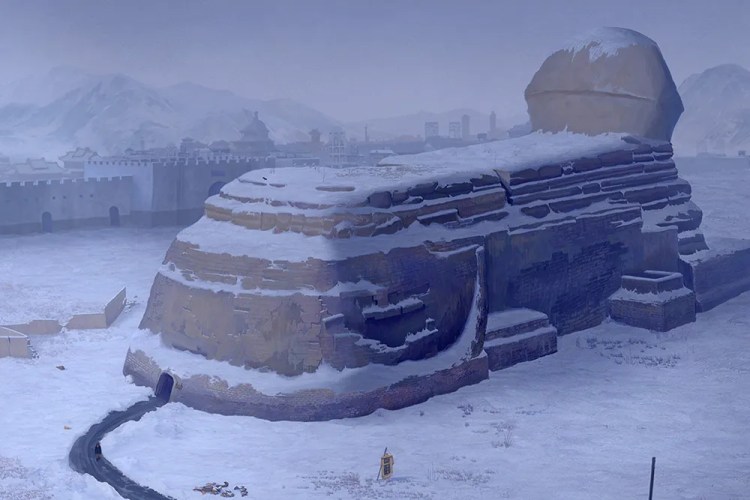
Maja: For most of the film we’re watching a snowy landscape which looks like Northeast China, although it could technically be somewhere else. You’re from the Northeast, how does your personal background influence your work?
Xu Zao: The geography, ecology, and climate of Northeast China all influence the creative style of its filmmakers. That’s why you can find certain similarities among the works of many filmmakers from the Northeast. There’s nothing we can really do about that—it’s something that comes from our “genes.”
This time in Germany, many German audiences have also really liked the film. Although it hasn’t been officially released yet, the feedback from many media outlets has been very positive. They have been able to sense the emotions in the film.
And after coming to Germany, I discovered that Germany is actually quite similar to my hometown. The urban environment, people’s state of mind, and even the food are all quite similar to Northeast China. So when these external factors are similar, the things inside people’s hearts can actually be quite similar as well.
Maja: Yes, Germany and Northeast China really are quite similar. Even the food in both places includes things like meat stews. I’m also curious about the digital world in the film. It was shot in live action, while the real world is animated. Why did you make that choice?
Xu Zao: Originally, the entire film was going to be animated. Later, I started thinking about how to create a stronger distinction between the virtual world and the real world. The virtual world and the real world are inherently different, of course, and we experimented with many different ways of representing that difference. In the end, though, I felt that live action worked better because it created the strongest contrast with the 2D animation. 2D animation inherently has a sense of flatness. It is linear and abstract. The live-action footage, by contrast, is highly three-dimensional and vivid. For the protagonist, his original life is very monotonous and dull, so using 2D animation to represent it felt appropriate. But once he enters the virtual world, that place suddenly becomes colorful, three-dimensional, and vivid, almost like an entirely new and more attractive world. So the contrast also fits the logic of the story.
Q: There’s a particularly interesting character—the extra wearing glasses. At first I thought you had played him yourself. Then I realized you hadn’t. Who is he?
Xu Zao: He’s a Chinese director named Li Hongqi.
Maja: Ah, Li Hongqi. I hadn’t seen a photo of him before. But I’ve seen Winter Vacations, which he shot in Northeast China. I can imagine his own personality is very similar to the character in Light Pillar—there’s something slightly inscrutable and neurotic about him.
Xu Zao: Yes, he’s extremely laid-back.
Maja: How would you define the characteristics of “Northeast Chinese cinema”?
Xu Zao: Maybe it’s winter. The essential gene of all the good films from Northeast China is this: how do people live optimistically in a place where the weather is extremely cold and the conditions of life are so harsh? That may actually be what most films from Northeast China are really trying to express.
Q: How has Light Pillar changed compared with your previous work?
Xu Zao: In terms of production, it’s a little more polished. Light Pillar was made by a somewhat larger team, so it’s no longer quite as “completely independent” as my earlier work. But in terms of what I’m trying to express, including the visual style, it’s actually still the same. The images have simply become more refined, and the character animation has a slightly higher frame rate.
Maja: Did you actually visit those old film studios?
Xu Zao: Yes. Before production, we basically traveled to around fifteen or sixteen film studios across China. We then incorporated the things I found interesting or representative into the film. A lot of the locations are really based on visual references. For example, the setting from A Chinese Odyssey is in Yinchuan. And the Sphinx setting you see in the film is actually in a film studio in Anhui. There are many different cinematic landscapes mixed together.
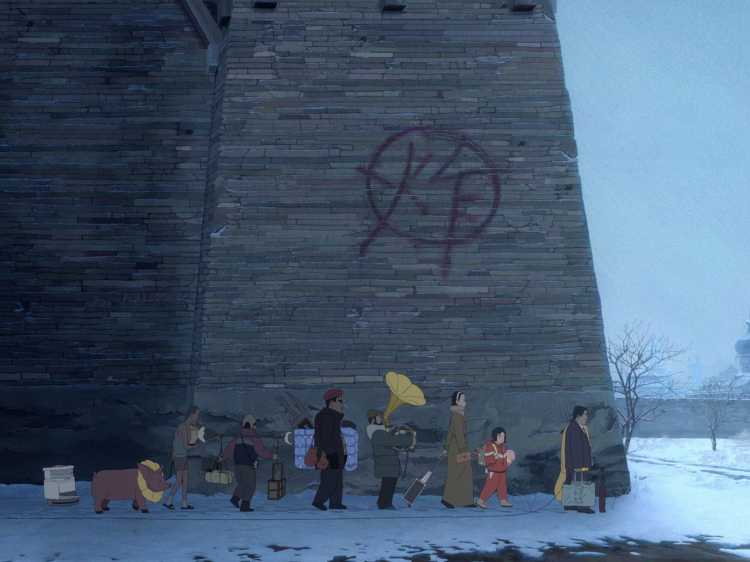
Maja: That’s interesting, because film studios themselves are a kind of hybrid space between East and West. While watching the film, I kept wondering who that old director in the wheelchair was.
Xu Zao: There were actually some specific ideas about him at the beginning, but later I didn’t want to make him too specific, so I chose to show only the back of his head. He can be anyone you imagine him to be.
Maja: I thought of directors such as Xie Jin or Zhang Yimou. (laughs) You mentioned earlier that the climate here is similar to Northeast China. Apart from that, do you think audiences in Berlin have responded differently? For example, when you were at IFFR, was there any reaction that surprised you?
Xu Zao: When I was in Rotterdam, I honestly didn’t expect the film to resonate with so many people. After all, it’s a story that is deeply rooted in China. But when I actually took it to international film festivals, I discovered that the difficulties people face and their social conditions are actually quite similar. For example, after a screening in The Hague, there was a student from Amsterdam. He was a local, and he said that his problems finding employment were very similar to what we see in the film.
So before that, I had assumed that people’s responses would be very different. But when we actually started talking, I realized that these problems are essentially the same everywhere. Coming to Berlin this time, I also feel that the emotional connection with audiences is actually very strong. There haven’t really been any questions that went particularly beyond what I had imagined.
Maja: I think it’s not just about work, but also about relationships. Especially in Berlin, a lot of people are constantly trying to get into a relationship, but they can’t find a partner, so they end up feeling extremely lonely.
Xu Zao: Yes, that’s a global issue. It’s not really a “flaw”; it’s a state of life that we need to learn to coexist with. We need to accept it. And humanity’s capacity to endure loneliness is actually growing stronger and stronger.
Maja: Since it’s a contemporary story, why did you choose to set it in the near future?
Xu Zao: Because I didn’t want it to be too far removed from reality. If it were set in a particularly distant future, the story might feel somewhat untethered. But if it’s set in the near future, it’s something we can imagine and relate to. For example, space tourism projects are already being planned, and people have already traveled into space. So something like that could actually happen within the next ten years.
Personally, I prefer this kind of science fiction that stays close to reality. With particularly grand-scale science fiction films, I sometimes feel that they’re a little too distant. I prefer to approach science fiction from a very small point of entry, from a perspective that is close to us, and use that to look at questions about the future.
 sailuluo 赛璐珞