
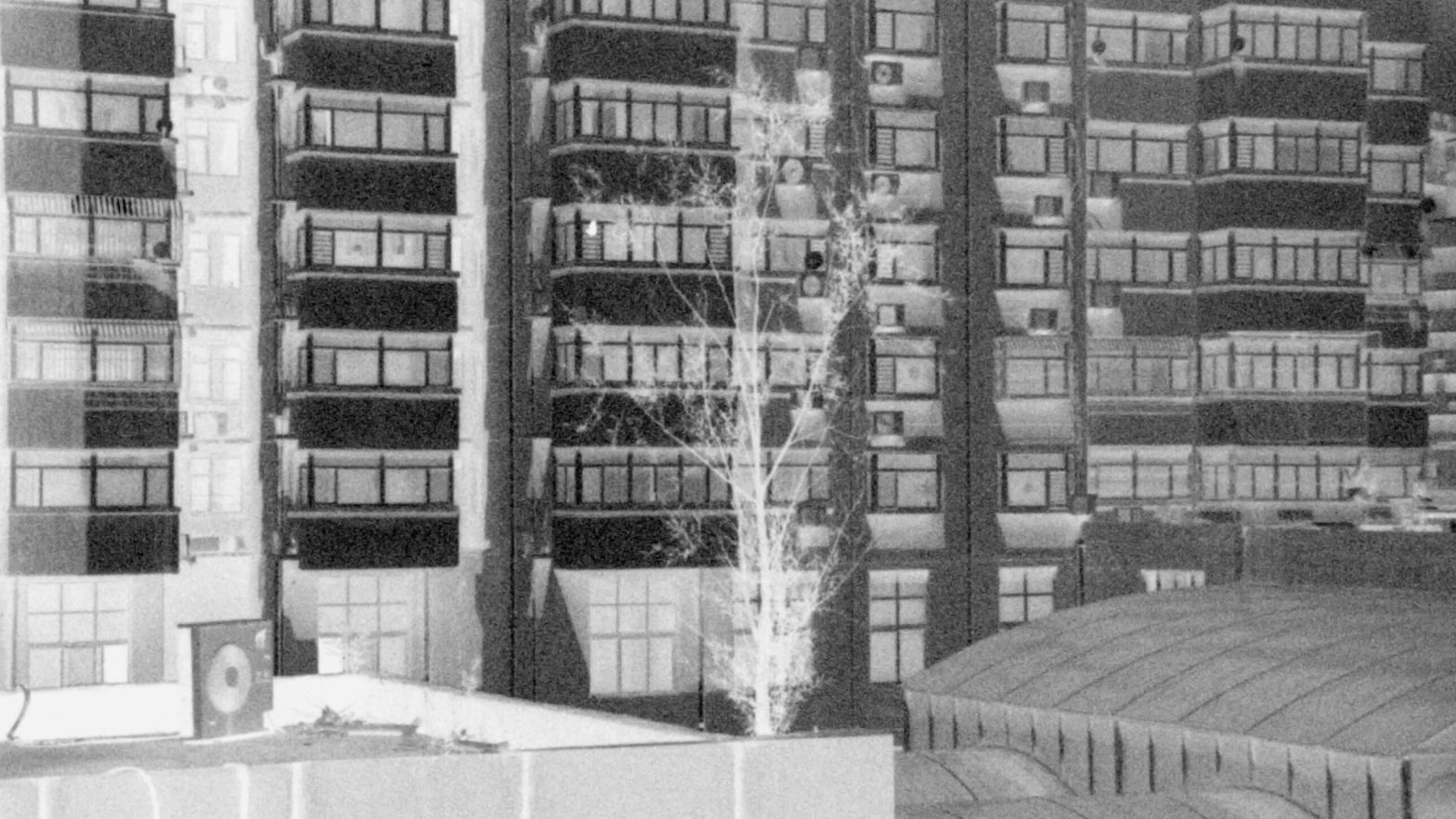
This year’s International Film Festival Rotterdam featured a strong lineup of contemporary experimental Chinese and Hong Kong films, including works by Peng Zuqiang, Nan Wang, and Sheungman Yim. Among them was Paris-based filmmaker Zhou Zhenyu, who brought to Rotterdam his new short film Branches from Concrete.
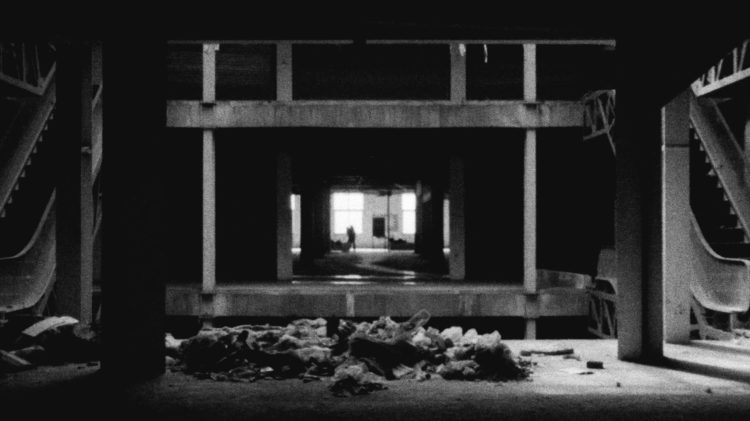
In the film, past, present, and future seem to collapse into one. The space of an unfinished shopping mall — a relic of the real-estate development boom and an era of early capitalist yearning — becomes the kernel of a home, a private space within the public sphere where older couples dance together and children play. Branches from Concrete is permeated by a sense of the uncanny, much like the feeling of returning to one’s hometown after years away, only to find it both familiar and strange at the same time. However, director Zhou Zhenyu avoids nostalgia — a feeling so easily exploited and commodified today — in favour of looking toward the present and possible futures.
Zhou traveled to Rotterdam with Branches from Concrete sound designer Xu Mo and one afternoon at de Doelen we sat down to talk about the film. Branches from Concrete takes the form of an experimental film, but at its core lies the tradition of home videos. Zhou Zhenyu began working on the project while visiting his parents in his hometown of Hengshui, in Hebei Province in northern China, a three-hour train ride from Beijing. Therefore, the entry point for discussing his short film was an online project he curates: ACTANTIMAGE, which consists of digitised archival home videos recorded by French families from the 1950s onward.

Maja: I noticed that your main interest seems to revolve around home videos. Not only in your short films, but also on ACTANTIMAGE , the video platform you curate. Recently, many of the films featured there have been related to Latin America.
Zhou Zhenyu (hereafter Zhou): Yes, “family” has indeed been a subject I keep returning to, because I’ve realized that the definition of family constantly changes over time.
As for ACTANTIMAGE, I wanted to create a platform dedicated to collecting, archiving, and exhibiting amateur films, while also allowing these images to continue circulating within today’s short-video ecosystems. Most of the films date from the 1950s to the 1990s and consist of home videos.
What fascinates me is that the people who made these films probably never thought of themselves as “filmmakers.” It’s precisely this amateur condition that moves me. Their camera work feels closer to an instinctive way of seeing and recording — subjectively choosing what people, events, or objects are worth documenting.
The Latin American footage you mentioned actually comes from a French couple whose initials were MJC. While organizing the material, I discovered that from 1959 to 1994 they traveled almost every August. I could sense how carefully they planned these trips. Each time they shot around ten reels of 8mm film and later edited them into travelogue-like films of roughly ninety minutes.
Maja: Did you find all these reels at flea markets?
Zhou: Yes, mainly at second-hand markets in Paris. For a while last year, I went almost every weekend looking for them. It became addictive — like opening blind boxes.
A lot of these reels ended up in flea markets because, after elderly people passed away, their families had to clear out their homes. Dealers who specialized in second-hand goods would buy old furniture and objects very cheaply, and these 8mm and Super 8 home movies would also end up being sold at the market.
Looking back now, the emergence of 8mm and Super 8 film formats represented a kind of “democratization of technology.” After World War II, Europe developed rapidly during reconstruction, and image recording became part of everyday consumer culture. You can see this in Kodak’s advertising brochures from the time: they often featured middle-class housewives holding 8mm cameras and filming family life.
As a result, the content of these films became quite concentrated — mainly travel, family gatherings, and documenting children growing up.
At the same time, this also reflects the democratization of image-making, providing a non-official perspective. Earlier, film technology had largely served military, surveillance, and official documentary purposes.
Maja: What do you find most special about these travel films?
Zhou: What strikes me is that they’re not just touristic “check-in” recordings. The filmmakers genuinely observed local people’s lives and labor. I really like the sense of “capturing” in their images.
But at the same time, this way of looking also contains a specifically European outward gaze — a gaze directed toward the Other.
For me, through these images, it almost feels as if I can return the gaze of the people appearing in the footage. That feeling is very strange and moving.
Maja: Those images look outward, while your short film feels much more inward-looking.
Zhou: Yes, this short film gradually took shape through several returns to my hometown.
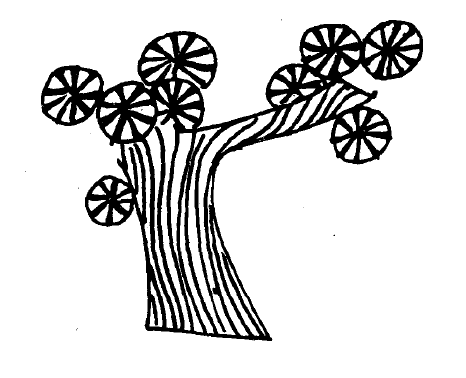
After the pandemic, I went back home to spend time with my parents after several years away. One day, looking out from my apartment window, I noticed a wild tree growing on top of an unfinished shopping mall across the street. I thought it was incredible because there was barely any soil there, and yet the tree had managed to grow. It looked almost like a sculpture.
Later, when I saw the tree again, it had somehow been snapped in half and was hanging in mid-air. At that moment, I felt that its condition resembled my own situation at the time. It also brought back many childhood memories, as if I had returned to the old home of my memory.
Maja: So is the shopping mall basically abandoned now?
Zhou: Originally, it was planned as a mixed residential-commercial real-estate project, but the funding chain collapsed and it was left unfinished. Later, residents from the surrounding neighborhood collectively reoccupied and reused the space on their own initiative. Some people dance there, others practice martial arts or play table tennis.
Maja: Plants and culture have something in common: they grow naturally, even in hidden spaces with almost no soil. The scenes showing people social dancing are particularly beautiful.
Zhou: Yes, they reorganized part of the space according to the needs of dance practice. They installed stretching bars, standing mirrors — actually quite a complete setup.
After spending time with them, I realized they were different from the stereotypical image of public-square dancing groups. They don’t blast loud music. They’re more interested in finding relatively quiet places.
Especially in the evening, when the sunset shines directly into the space, the light becomes incredibly beautiful.

Maja: I also wanted to ask about the acupuncture scenes.
Zhou: That sequence was filmed spontaneously while I was taking care of my mother during her recovery after surgery. Seeing the doctor place rows of needles into my mother’s abdomen was visually very striking to me.
It made me think about my own state as a fetus inside the womb — that curled-up sensation. Perhaps the womb is the very first “space” we ever encounter. Even if we don’t consciously remember it, the experience remains inscribed in our subconscious.
This state also reminded me of the dung beetle balls mentioned in the film. When we were children, we used to dig them out of the soil, throw them at each other, even crush them. But later I learned that each dung ball actually contains a larva inside, and the ball itself serves as nourishment for the larva to grow into an adult beetle.
Maja: The sensation of acupuncture is very strange for me. It feels like previously ignored pain returning, finally having a chance to be released. Sometimes I suddenly taste iron in my mouth. Acupuncture is associated with “metal,” the tree is “wood,” and your title also contains “earth.”
Zhou: I think concrete, as a man-made building material, is itself a quintessential symbol of modernity. Its malleability makes urban mass production and replication easy. As a result, cities increasingly resemble one another — all becoming grids of square forms.
The same applies to family structures. People born in the 1980s like us were mostly only children: father, mother, one child — itself a kind of standardized structure.
In China, we often talk about “other people’s children” as an ideal standard. To me, that also reflects this same logic. It’s not about understanding a specific individual, but about measuring everyone according to one unified standard.
But I think what truly matters between people is understanding. A lot of suffering comes from not being understood, not being seen.
Maja: In rapidly changing post-socialist countries like China or Poland, the generational gap is huge. Parents and children struggle to understand each other because their experiences are so different. Was the final shot your father?
Zhou: Yes, the final shot is my father. In fact, this project is fundamentally a family film for me. Through the act of filming, I wanted to rebuild a connection with my parents and create something together.
For many years, they never really understood what I was doing. This became an opportunity for mutual understanding. I listened to stories about their childhoods, and together we transformed those memories into concrete gestures and scenes.
For example, my father once told me that when he was young, there was a flood upstream and fish from the reservoir were washed into the city. He and his friends went out catching fish, and it remained one of his happiest memories. Later, on a rainy day, I asked him to hold a flashlight and reenact the act of searching for fish in the floodwater.
Many scenes in the film actually emerged from our conversations.
Maja: Last November in Beijing, I visited Yang Fudong’s exhibition about his hometown. He’s also from Hebei. Some of the films shot in Hebei featured actors dressed in fashionable clothes, but the Hebei shown on screen felt almost indistinguishable from the Northeast. Combined with the imagery of Northeast China from ten years ago, it almost looked like another imitation of Black Coal Thin Ice. As someone from Hebei yourself, how do you think the specificity of that place can be represented on screen?
Zhou: The characteristic of Hebei on screen? Personally, I think the word “vacancy” is quite fitting.
In the broader social discourse, people are constantly encouraged to study hard, leave for bigger cities, and settle there. Under those conditions, it becomes difficult to build an internal sense of identity. In images, this often creates a feeling of emptiness or hollowness. I think Yang Fudong’s 2007 film East of Que Village captures this rather precisely.
As for the Northeast, in my own memories, many Northeasterners settled in Hengshui when I was a child.
Xu Mo (hereafter Xu): Since you brought up Hebei, I’ll add something. Whether in art or culture, many things in Hebei are difficult to excavate because they’re not very visible. But I actually think that precisely this harsh and oppressive environment gives rise to something special.
For example, some of the underground rock music from Shijiazhuang. I think those things are incredibly powerful. They grew slowly under economic pressure, discursive pressure, pressure imposed from above. And they often developed outside the mainstream rather than within it. So I think Hebei exists in a very particular state: many avant-garde and rebellious ideas are hidden underground, buried beneath the soil.
Maja: As if they were buried.
Zhou: Exactly. Some forms of expression are concealed beneath an apparently calm everyday surface, but underneath, things are always moving. Like plants struggling to survive through cracks.
Maja: Why is that?
Zhou: Think about Hebei geographically surrounding Beijing and Tianjin. Hebei constantly supplies them with resources and labor. At the same time, much of the pollution, industry, and waste eventually flows back into Hebei.
In that context, expressions emerging from Hebei are naturally overlooked.
Maja: When I visited Hengshui, I particularly remember the huge number of high residential buildings. But it seemed to me that there was almost nobody living in those apartments.
Xu: That issue is actually very real. Hebei is simply too close to the capital. If it became too economically developed, it would become “harder to control.” As a region surrounding the capital, its primary role is to provide stability and supply.
This creates a very unique political and economic environment. China has many similar triangular regions — Hebei-Beijing-Tianjin being one example. Officially, it’s framed as “joint development,” but in reality, one area develops while another supplies the blood. Hebei often occupies the latter position. It gives a lot, but receives very little in return.
Maja: So many talented young people eventually leave.
Xu: I once heard a joke: “The lifelong dream of Hebei people is to escape Hebei.” But behind that joke lies a very serious developmental problem. The region itself struggles to achieve large-scale development, so it remains stuck in a kind of limbo. In such an environment, the word “hope” becomes complicated. Ordinary people may not feel intensely oppressed, but they rarely talk about “the future becoming better.” People don’t think, “Tomorrow I’ll get rich,” or “I’ll have some good developments in my life” Instead, they think about leaving. Of course, that doesn’t mean nobody still tries to move things in another direction.
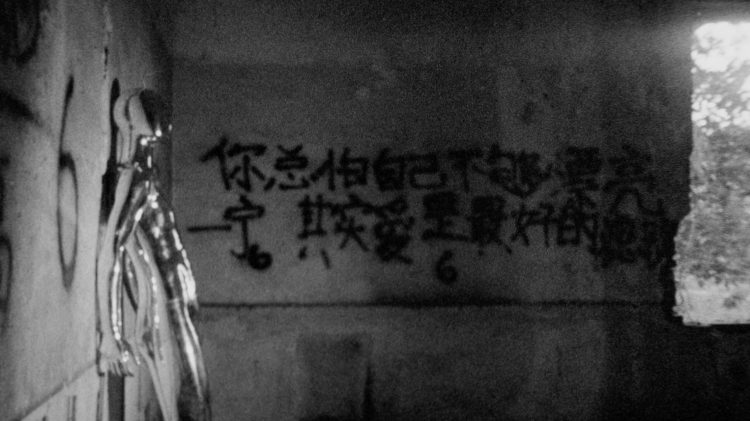
Maja: I kept wondering afterward why you included a mannequin in the film.
Zhou: At first, I filmed many architectural spaces, mostly from my own perspective. But later I kept thinking about how to connect all these different elements together. Then, during a trip back to China last year, I noticed this reflective mannequin. I was immediately fascinated by its metallic texture. When you look at it, it constantly produces reflections; its surface continuously distorts reality, warping both space and human figures. And when you return to the abandoned space itself, you realize it was originally designed as a commercial space, yet in terms of its actual use, it too has undergone a kind of transformation.
Maja: You mainly used black-and-white imagery. Why?
Zhou: Black-and-white imagery inherently creates a sense of distance, as well as a feeling of unquestioned reality. It’s clearly distinct from the colored world we normally see. But I don’t necessarily think the colored world we perceive is the world in its original state. Color itself is also a kind of “filter” produced by the human optical system. That’s why, in the emotionally charged final section of the film, I used color film — I wanted it to fall slightly out of the black-and-white structure and return to something more concrete and immediate. Sometimes I also think that perhaps, in the “black-and-white world” we imagine, color might instead become something belonging to the past. When future species reinterpret these colored images, the colors we perceive today might be reorganized within an entirely different cognitive system.
Maja: That’s very interesting. In a way, black and white almost feels like the color of the future. A bit like Alphaville by Jean-Luc Godard.
Zhou: Perhaps it’s a future that has become extremely binary — reduced to nothing but black and white.
*Branches from Concrete premiered at the 2026 International Film Festival Rotterdam.

