
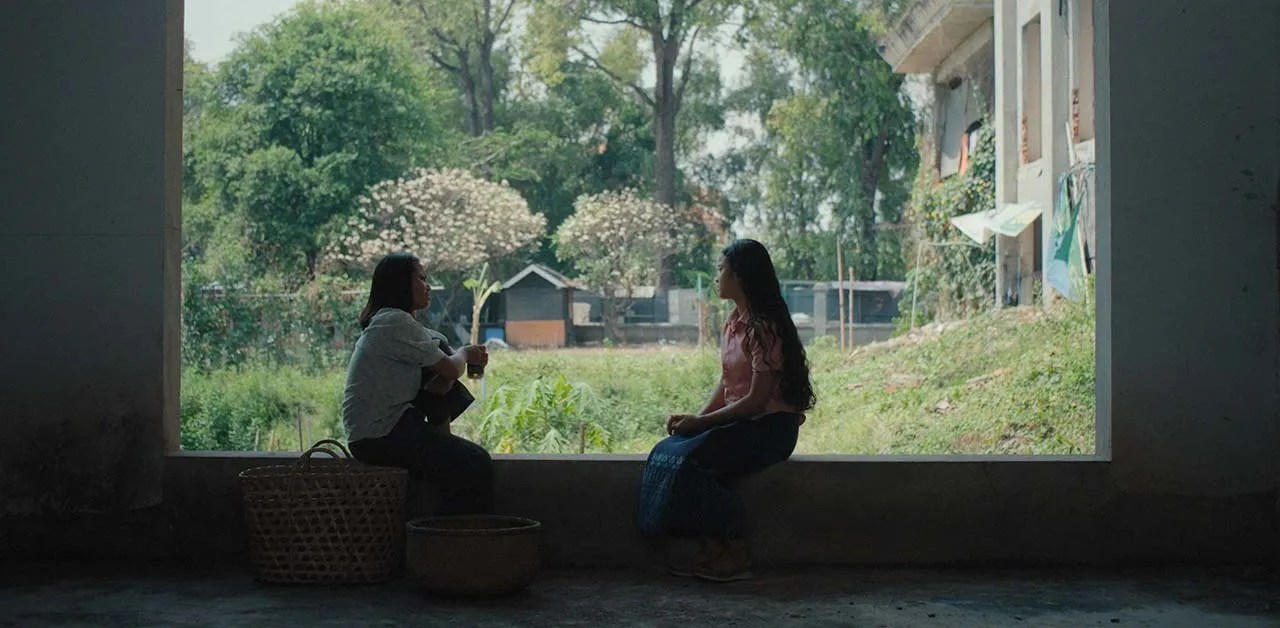
Becoming Human (ជាតិជាមនុស្សា), the feature-length debut of Cambodian filmmaker Polen Ly, tries to imagine the experience of a ghost spirit unwilling to part with this world and undergo reincarnation once again. In the film, the trauma of the Cambodian genocide lingers in the landscape, pinning spirits and people to the ground and forcing them into hiding, while urban redevelopment, modernisation, and contemporary Cambodian politics push people out of their havens in search of other secluded places. Becoming Human asks what it means to be human. Is it free will? Is it doubt? A resistance to what society tells us we are supposed to do?
Completed as part of the Biennale College Cinema 2024 programme, which provided a €200,000 production grant, the film premiered at the 82nd Venice International Film Festival and was selected as the opening film of this year’s CinemAsia Film Festival in Amsterdam. I sat down with Polem Ly at the Eye Filmmuseum café on a sunny afternoon to talk about his experience as a self-taught filmmaker, the making of Becoming Human, and being part of Cambodia’s independent filmmaking community.

Maja: Yesterday you mentioned that it’s not your first time in Amsterdam. You’ve been to IDFA before.
Polen: I’ve been to IDFA, and last year I came for an artist event organized by the Prince Claus Fund. I got one of the fellowship awards, so artists from the Global South gathered together. I think Amsterdam has already become like a family place for me. I also have friends here now, so it was nice to be back. And of course there are the museums. I remember the first time I came here I discovered so many things.
Maja: It seems you have a destiny with this city.
Polen: Sometimes people have a destiny with a certain place and time. I feel that way here. In Cambodia, the culture of going to cinemas, museums, or galleries is still very small. We don’t really have galleries—only a few independent spaces. So for me, being able to come here and watch so many things, see so many things, it’s very inspiring. I remember the first time I came here I went to the Eye Filmmuseum and saw an exhibition by Werner Herzog. Then I went to The Hague to visit another museum. It’s a wonderful place for artists.
Maja: Maybe people here don’t always appreciate it because they’re used to it.
Polen: Maybe. When you live with something for so long, perhaps you stop seeing it.
Maja: I was looking through some of your previous interviews, and I couldn’t really find much about how you got into filmmaking. I know you’re self-taught. How did it start?
Polen: It’s actually a funny story. After high school I became a medical student because my parents always wanted me to become a doctor. At that time, in order to study medicine, I first had to study French. At the French Institute there was a multimedia library where you could watch a lot of films.
That’s where everything changed. I watched many independent films from Europe and Asia, and I slowly fell in love with cinema. Before that I had mostly watched soap operas on television. Suddenly I was discovering all these different forms of storytelling.
One day I took a small digital pocket camera and just started filming things. I edited them together and uploaded them to YouTube. Later, some NGOs asked me to make documentaries or short films for them. I learned by watching films and by making them. Of course I made millions of mistakes, but I also learned from those mistakes.
When you keep making films, you develop a space where you can reflect on your own work—what’s good, what isn’t. Little by little I discovered myself as a filmmaker. But even now, when I look back at my first short film, I still feel the same core that existed there from the beginning.
Maja: What would you say that core is? What themes are you most drawn to?
Polen: I think I’m very interested in the feeling of losing something—or longing for something that no longer exists. My first short film was about a girl searching for her lost dog. My previous short film was about a girl who lost her home because of a flood. And Becoming Human is about a spirit who loses her cinema because of urban development, but before she dies she loses home because of war.
I think I’m always drawn to this longing for something that has disappeared. At some point I realized this might also come from my own life. When I was growing up, my family lost our house because of a highway project. That house doesn’t exist anymore. When I wrote Becoming Human, especially the scene where Thida comes back and touches the grass, it became almost like self-therapy for me.
I still remember my old house very vividly—the kitchen, the food we ate there, the memories with my family. Now all of that is buried beneath a highway. I think this feeling of longing was always inside me without me realizing it. A kind of subconscious trauma that keeps haunting me, and maybe I express it through filmmaking.
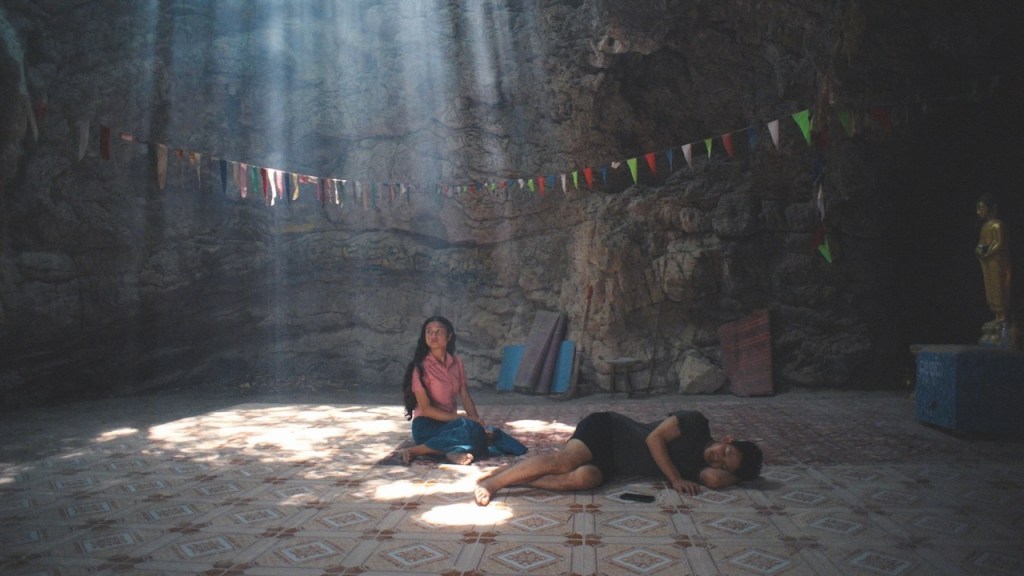
Maja: The scene where Thida touches the ground is also connected to the tree later on. There’s this recurring image of trees in your films. What do trees symbolize for you?
Polen: My previous short film also had a girl climbing a tree. I grew up in the countryside, so my childhood memories are full of climbing trees—or falling from trees and getting scolded by my mother afterwards. For many Cambodian children from the countryside, climbing trees is a very common memory.
In my films, I think trees become a way for characters to reconnect with memory and heal. In Becoming Human, Thida says earlier in the film that the last time her family was together before the war, she was sitting at the top of that tree. So climbing the tree again becomes a way of accepting both the pain and the beauty of the past.
When we worked on the music for that scene, my composer kept asking me what kind of feeling I wanted. I told him I wanted something like a mother’s lullaby. The scene is not meant to feel tragic or full of suffering—it’s more melancholic, calming, like soothing a crying child. So when she climbs the tree and the music begins, it’s almost like someone telling her: “It’s okay now.”
Maja: So the tree becomes almost like a cradle—or a mother or grandmother singing.
Polen: Yes. During the writing process, I was actually worried that the scene wouldn’t be understandable enough. But during editing and sound design, I realized I wanted it to remain more open, so audiences could connect with it through their own experiences.
That’s why the scene is so simple. She comes back, she gets emotional, she touches the grass, she climbs the tree. There’s no explanation, no voice-over. Different people can interpret the tree in different ways.
Maja: When I watched the film, I kept thinking about the question the title raises: what does it mean to become human?
Polen: I think the question of what it means to be human is universal, but it changes depending on political and cultural contexts. When I started writing, I already knew the film would be called Becoming Human because it’s about a spirit who later becomes human. But for me, the title also came from questioning my own existence in Cambodia.
Cambodia has a landscape filled with repeated trauma. There is the trauma my parents experienced during the genocide, and then later generations inherit different forms of trauma too. As an artist and filmmaker, I’ve experienced threats and pressure from the government not to talk about certain things. When you live under those conditions, you swallow the trauma inside yourself. I feel like many layers of trauma overlap with each other.
So I kept asking myself: what does it mean to live as a human being in this kind of landscape? You cannot return to the past, and the future feels uncertain. The present can feel like a closed box. Cinema became a space where I could express those emotions. I believe deeply in the resilience of human beings, especially artists who continue to create under difficult conditions.
For me, cinema itself is a form of resistance. It carries voices from one place to another. And resilience—that ability to continue despite everything—is also part of being human. When you look at the world today, with war and violence everywhere, resilience becomes a way for us to keep searching for how to live together.
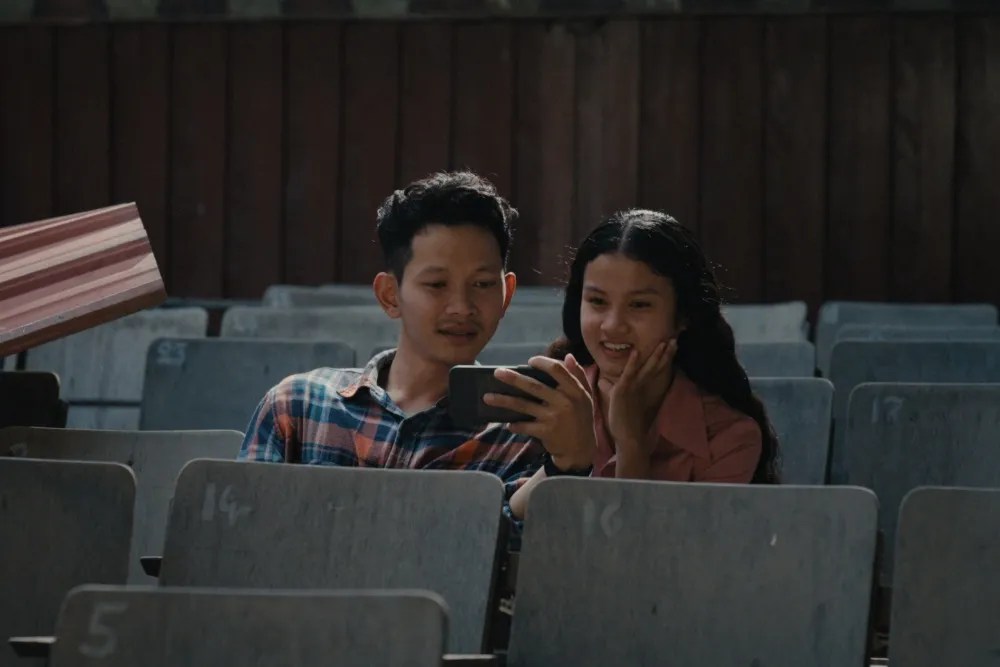
Maja: In the film, cinema is both a form of resistance and a place of escape. I also loved the fact that the characters watch films on a phone inside this abandoned cinema. It still feels like cinema.
Polen: Yes. I understand why people defend the big-screen experience, because cinema is also about being together with other people and sharing emotions. Last night, for example, watching a film with a large audience was a very powerful experience.
But in Cambodia, many people only have smartphones. Sometimes there are no cinemas nearby, so the phone becomes the way stories reach people. For me, what matters is receiving the story. I actually discovered many films through pirated DVDs. When I was in Phnom Penh, I found this place selling pirated discs, and it felt like heaven—almost like discovering the Criterion Collection. There were so many films I had never seen before. I could rent them and watch them on my computer. Without those DVDs and without a computer, I probably would never have discovered world cinema. In Cambodia, commercial cinemas mostly show blockbusters or horror films. Those pirate DVD stores became another kind of film school for many of us.
Maja: I also wanted to ask about Thida’s costume. Was it inspired by something specific?
Polen: Yes. Because Thida is the guardian spirit of the cinema, many Cambodians might expect her to wear a traditional costume associated with angels or spirits. But my producer Daniel showed me photographs from refugee camps after the Cambodian genocide. Many people fled across the border to Thailand and waited in camps before emigrating to places like France, the Netherlands, or Germany. In one of the photographs, there was a woman with long hair wearing clothes very similar to Thida’s costume. I immediately felt it was perfect. Since Thida’s story also involves crossing the border and stepping on a landmine, the costume connects her to the memories of refugees from that time. In a way, it became a tribute to that woman in the photograph.
Maja: The underworld in the film is also fascinating because it feels bureaucratic rather than mystical.
Polen: That was intentional. I didn’t want the underworld to feel like fantasy. In Cambodia we do have beliefs about heaven, hell, and rebirth, but I wanted the underworld in the film to resemble the bureaucracy people experience in everyday life. There’s corruption, favoritism, little abuses of power. You can see it in how the agency worker treats Thida differently from other people, or how she speaks to her assistant.I wanted it to subtly mirror Cambodian social structures. It was also a way of making fun of bureaucracy. At the same time, I’ve always been fascinated by questions surrounding rebirth. When I was a child, older people always told me that after death, souls are reborn. But I kept wondering: what happens in between? Who organizes it? Where do souls wait? Those questions stayed with me.

Maja: IMDb labels the film as fantasy, but stylistically it feels much more realist.
Polen: I don’t really see it as a fantasy film either. It’s a human film. The main character just happens to be a spirit. Even Thida doesn’t have special powers or visual effects. She’s simply there—a presence.
Maja: There is only one scene in which Thida does a trick to prove she is a ghost. It felt very much like it was taken from a George Méliès’ film. Becoming Human is very much connected to the history of cinema itself.
Polen: Yes. It’s also about losing cinema itself—not cinema as an art form, but cinema as a physical place. In Cambodia, most old cinemas disappeared after the war. Films moved into shopping mall multiplexes. The cinema we used in the film is in Battambang province. It still exists, but it’s abandoned. I think there’s now a disconnection between younger generations and those older cinemas.
Maja: I’m also curious about Anti-Archive and the filmmaking community around it.
Polen: Anti-Archive was founded by Davy Chou after he came to Cambodia and gathered young people who were curious about cinema. He organized cine-clubs where people could watch films together and discuss them. For me, it became a way to meet others who were passionate about cinema. Anti-Archive also started producing films by young Cambodian filmmakers like Kavich Neang. What was exciting was that these films felt very different from mainstream Cambodian cinema, which often focuses on horror or romantic stories. These filmmakers were talking about contemporary Cambodia—about the present. When I began working with Anti-Archive, first on my short films and later on Becoming Human, I felt part of a generation trying to question things: our history, our uncertain future, and the conditions of the present. I think it’s important for my generation to keep asking questions.
Maja: Cinema itself becomes a form of questioning.
Polen: Exactly. If you look throughout film history, filmmakers have always questioned the realities of their own time. Even directors I love, like Krzysztof Kieślowski, were deeply questioning their era through cinema. That’s what cinema does—it keeps asking questions about the present, the future, and the world around us.
Maja: Maybe that’s what keeps us hooked: the desire to wonder.
Polen: Yes. Sometimes it’s good to wonder. Otherwise, we would simply accept everything we’re told.